Diaghilev's Ballets Russes

Diaghilev's Ballets Russes
1909-1929

Welcome Balletomanes

This Blog is dedicated to preserving and celebrating the history and memories of Diaghilev's Ballets Russes, its legendary ballet dancers, choreographers, scenery artists, musicians and composers.
Showing posts with label Theatre du Chatelet. Show all posts

Wednesday, May 19, 2010

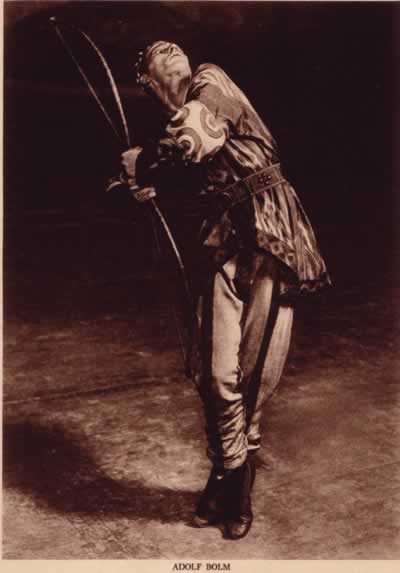
Prince Igor, Paris Premiere-May 19, 1909

Prince Igor was first performed in St.Petersburg, Russia, in 1890. It is an opera by Alexander Borodin, written in four acts with a prologue. The composer adapted the libretto from the East Slavic epic The Lay of Igor's Host, which recounts the campaign of Russian Prince Igor Svyatoslavich against the invading Polovtsian tribes in 1185. The opera was left unfinished upon the composer's death in 1887 and was edited and completed by Nikolai Rimsky-Korsakov and Alexander Glazunov.

The world premiere of the ballet was given in St. Petersburg on November 4, 1890 at the Mariinsky Theatre. Set designers were Yanov, Andreyev, and Bocharov, while
Lev Ivanov was balletmaster.
Moscow premieres followed later.
The first was given in 1892 by the Russian Opera Society, conducted by Iosif Pribik. The Bolshoi Theatre premiere was given in 1898 and was conducted by Ulrikh Avranek
Other notable premieres were given in Prague in 1899, and in Paris on May 19, 1909, with Sergei Diaghilev's Ballets Russes and Fokine’s choreography. London saw the same production in 1914 conducted by Thomas Beecham.

In 1915, the United States premiere took place at the Metropolitan Opera, but staged in Italian and conducted by Giorgio Polacco.

Wednesday, May 5, 2010

Le Dieu Bleu By Artist Jean Cocteau


Le Dieu Bleu is a one act ballet by Jean Cocteau and Federigo de Madrazo. Fokine was the choreographer and music was by Reynaldo Hahn with décor and costume by Leon Bakst. Le Dieu Bleu premiered May 13, 1912 at Theatre du Chatelet in Paris.


Cocteau wrote the scenario for Ballets Russes’s Le Dieu Bleu after working with Diaghilev since 1911, and designing posters for Spectre de la Rose using portraits of Nijinsky and Karsavina, in 1912. Cocteau and Hahn were inspired by Hindu legends, and Fokine the bas-reliefs of Brahman temples and Siamese dancers. Sadly, Le Dieu Bleu was not successful and removed from the repertoire the following year.

Sunday, April 11, 2010

Picasso's Parade Ballet Costumes

Parade is a realistic ballet in one scene, based on a theme by Jean Cocteau. The music was done by Erik Satie, choreography by Massine, curtain, décor and costumes designed by Pablo Picasso. The first performance of Parade was at Theatre du Chatelet in Paris on May 18, 1917.

Cocteau says that the first draft of the Parade ballet was a brief ballet project called David, something he had sketched out in 1914. The ballet was to take place in front of the entrance booth of a traveling fair. David was never written, but Cocteau’s first contact with Erik Satie was in 1915, with his collaboration with Picasso beginning the following year.

Diaghilev met Picasso in the spring of 1916 when a mutual friend, Mme. Eugenia Errazuriz brought him to Picasso’s studio. It was then that Diaghilev commissioned Picasso to do the mise-en-scene for Parade. Both Picasso and Cocteau left for Rome in February of 1917, where Diaghilev’s Ballets Russes was dancing. There they met and worked with Massine.

Among the costumes Picasso designed was a horse, initially with a mannequin-rider. During the dress rehearsal, the rider fell off of the horse causing the audience to laugh, so it was removed for the remaining performances. The costume for the American Girl, which Picasso had not sketched, was actually bought the day before at a sporting goods store. The costume for the Female Acrobat that Massine had added at the last minute was made of hand-painted spiral designs Picasso painted directly onto Lydia Lopoukhova’s legs.

After a three year absence, Diaghilev’s Ballets Russes returned to Paris’s Theatre du Chatelet with Parade, a pioneer Cubist theatrical spectacular. Satie and Cocteau often disagreed regarding the noises that Cocteau wanted added to Satie’s scores. But, Cocteau was over ruled by Diaghilev and they were left out.

When the curtain went down on Parade, the audience was violent and contradictory. It was acclaimed by many intellectuals, but the public didn’t like it. It was well ahead of its time and was never added to the regular repertoire of the Ballets Russes.

In 1923, when Diaghilev wanted to restage the ballet, he asked Picasso to touch up the curtain which had been taken over by mildew. Picasso refused saying that it resembled the deteriorated frescoes of Pompeii and should remain that way!

Read "DIAGHILEV And the Ballets Russes" by Boris Kochno, 1970.