Diaghilev's Ballets Russes

Diaghilev's Ballets Russes
1909-1929

Welcome Balletomanes

This Blog is dedicated to preserving and celebrating the history and memories of Diaghilev's Ballets Russes, its legendary ballet dancers, choreographers, scenery artists, musicians and composers.
Showing posts with label dance. Show all posts

Wednesday, August 24, 2016

Anna Pavlova: Mega Brand Spokeswoman

Recently, there has been a lot of buzz around ballerina Misty Copeland's recent sponsorship deal with the mega brand Dannon Oikos yogurt. While I am always happy to promote ballet and dancers, and I am additionally supportive of their need to supplement income, she is not the first. Ballet dancers have been hired to promote products for over a century.


There are many samples of ephemera in my Russian Ballet History Collection that feature dancers and even composers, like Stravinsky, hocking consumer products. Today, I wanted to focus on one ballerina and one product; Anna Pavlova and Adams Black Jack Chewing Gum.

Ms. Pavlova is featured on page 8, in the American Chicle Company's advertisement in The Detroit News on February 14, 1917, nearly 100 years ago.

The text in the ad itself is very romantic:
 
Anna Pavlowa writes: The poetry of dancing alone can interpret my admiration for the delightful licorice flavor in Adams Black Jack Gum.


In 1884, licorice flavor was added to the Adams Black Jack chewing gum making it the first flavored chewing gum sold in the U.S. While the packaging in the ad states that it comes in five tablets, it was actually the first chewing gum offered in what we today call sticks

On the bottom of the pack it claims to be "good for colds and coughs".  According to Web MD, some people do use licorice for sore throat, bronchitis, cough, and infections caused by bacteria or viruses. So it might pass today's label laws, but I am certain that a team of food industry label law lawyers would phrase it differently.

Chicle comes from a tree, like rubber from a rubber tree plant. The word "chicle" itself is comes from the Mayan word tsicte and it means sticky.  The word Chicle is still used for chewing gum in Spain and Chiclete in Portugal and Brazil.

Okay, okay I can tell that some of you are wondering about the other ads I mentioned in the beginning. In the 1920's, a British company/product called Virol & Milk (A protein/energy drink. No they aren't a new idea either.) featured three of Diaghilev's Ballets Russes dancers in an ad campaign: Lydia Sokolova, Serge Lifar and Leon Woizikowski.

Yes, I know, someone is going to say "but Misty is representing a mega brand". Well, how about Coca-Cola, is that MEGA enough? In the 1950's ballerinas were featured in a Coca-Cola color print ad.
https://www.facebook.com/BalletsRusses/photos/a.597964886957890.1073741834.106909499396767/1060764204011287/?type=3&theater
Coca-Cola is a registered trademark of the Coca-Cola Company

Monday, October 24, 2011

Lydia Lopokova Birthday Oct. 21, 1892

Lydia Lopokova was born in St. Petersburg, Russia on October 21, 1892. All of her siblings became ballet dancers, and one of them, Fyodor Lopukhov, was a chief choreographer of the Mariinsky Theatre from 1922-1935 and 1951-1956.

Lydia trained at the Imperial Ballet School. She left Russia in 1910, joining the Diaghilev's Ballets Russes. She stayed with the ballet briefly, leaving for the United States after the summer tour. She rejoined Diaghilev's Ballets Russes in 1916, dancing with her former partner Vaslav Nijinsky, in New York and later in London. She first came to the attention of Londoners in The Good-Humoured Ladies in 1918, and followed this with a raucous performance with Léonide Massine in the Can-Can of La Boutique Fantasque.

When her marriage to the company's business manager, Randolfo Barrochi, broke down in 1919, the dancer abruptly disappeared, but she decided to rejoin the Diaghilev for the second time in 1921, when she danced the Lilac Fairy and Princess Aurora in 'The Sleeping Princess'. During these years she became a friend of Stravinsky, and of Picasso, who drew her many times.

Lydia was known also as Lady Keynes, the wife of the economist John Maynard Keynes. In 1933, Lydia danced her last ballet role, as Swanilda in Coppélia, for the new Vic-Wells Ballet.

Read about her and her life in Bloomsbury book Ballerina.

Thursday, July 14, 2011

Mikhail Mordkin Passed Away July 15, 1944

Mikhail Mikhailovich Mordkin, Russian dancer and teacher was born in Moscow, on December 9, 1880, into the family of the violinist of the Imperial Theatres. At the age of nine he entered Moscow Imperial Ballet School. Mikhail Mordkin was one of two of the male stars of Diaghilev's Ballets Russes in 1909. Mordkin was trained at the Bolshoi, in Moscow, graduating from the Bolshoi Ballet School in 1899. In the same year, he was appointed soloist and then premier danseur. He joined Diaghilev for his Paris season as a leading dancer, ranking above Nijinsky. On the opening night of Ballets Russes in Paris in 1909, Mordkin danced the leading role in Michael Fokine's Le Pavillon d'Armide.

After the first season, he remained in Paris to dance with Anna Pavlova, going on to form his own company, All Star Imperial Russian Ballet, which toured America in 1911 and 1912. Mikhail returned to the Bolshoi and was appointed its Director in 1917.

He left Russia after the October Revolution, first working in Lithuania, and finally settling in the United States in 1924. He founded the Mordkin Ballet in 1926. His company included such distinguished artists as Hilda Butsova, Felia Doubrovska, Pierre Vladimiroff, and Nicholas Zvereff. But after a European tour, the company disbanded in the same year. From among his students in America, he formed a new Mordkin Ballet in 1937, now American Ballet Theatre. His student, Lucia Chase, helped to initially finance the company and after the first season, she took over the management from Mordkin.

Wednesday, July 13, 2011

Alexandra Danilova Passed Away July 13, 1997

Alexandra Danilova, or Choura, was born in Peterhorf, Russia on November 20,1903. She trained at the Imperial School of Ballet in St. Petersberg, Russia. After her graduation, she was asked to join the Corps de Ballet of the Soviet State Ballet at the Maryinsky Theatre. Danilova left Russian with the Soviet State Dancers, a company formed by fellow dancer Vladimir Dimitriev. During summer vacation from performances at the Maryinsky, the company toured Berlin, Germany and the dancers defected, never to return to Russia again. The company left Berlin, heading to London, where Danilova joined Diaghilev's Ballets Russes in 1924. When Danilova was asked to audition for Diaghilev, she refused, telling him, "If I am good enough for the Maryinsky, then I am good enough for you." That same year, George Balanchine joined Diaghilev's Ballets Russes as choreographer.

When Diaghilev died suddenly in 1929, his company was disbanded. Dancers were left to find other companies to dance for, but Danilova was 28 and considered too old for most companies. She was eventually offered a position with the new Col. de Basil's Ballet Russe , by her friend Leonide Massine.

Quickly, as one of the most popular dancers of her time, many theatre's would not book Col. de Basil's Ballet Russe without Danilova! She danced with the Ballet Russe de Monte Carlo from 1938 - 1945 where she was often partnered by Freddie Franklin. Danilova also guested with Sadler Wells in 1949, London Festival Ballet in 1952 and created her own "Great Moments of Ballet" tour dancing from 1954-1956.

Her last ballet performance was in 1957, but she appreared in a Broadway comedy/musical in 1958 called Oh, Captain!. She appeared in a single scene, a dance with the show's star, Tony Randall, which stole the show. Danilova was never good at handling her finances and found herself broke and unemployed again when ran into her friend George Balanchine on the streets of New York City in 1964. She told him of her plight and he instantly hired her to teach at the School of American Ballet. She remained with SAB until her retirement in 1989.

During her career, Danilova danced all the major ballerina roles and created principal roles in Balanchine works like The Triumph of Neptune (1926), Le Bal (1928), Dances Concertantes (1944) and La Sonnambula (1946). and she Choreographed Coppelia for NYCB in 1974. Danilova was a recipient of the Kennedy Center Honors in 1989. Danilova did make an appearance in the movie "The Turning Point" as a ballet teacher and coach.

Her autobiography, Choura, was published in 1986. There is a fabulous little documentary on Felia Doubrovska, that Danilova appears in. She and Felia are restaging a variation for Mikhail Baryshnikov.

Tuesday, September 14, 2010

Andre Derain Artist of the Ballets Russes


André Derain was a French painter and co-founder of Fauvism with Henri Matisse. André Derain was born in 1880 in Chatou, Yvelines, Île-de-France, just outside Paris. In 1898, while studying to be an engineer at the Académie Camillo, he attended painting classes under Eugène Carrière, and there met Henri Matisse. Matisse persuaded Derain's parents to allow him to abandon his engineering career and devote himself solely to painting; subsequently Derain attended the Académie Julian.


Derain and Matisse worked together through the summer of 1905 in the Mediterranean village of Collioure and later that year displayed their highly innovative paintings at the Salon d'Automne. In March 1906, the noted art dealer Ambroise Vollard sent Derain to London to compose a series of paintings with the city as subject. Derain put forth a portrait of London that was radically different from anything done by previous painters of the city such as Whistler or Monet. These London paintings remain among his most popular work.

In 1907 art dealer Daniel-Henry Kahnweiler purchased Derain's entire studio, granting Derain financial stability. He experimented with stone sculpture and moved to Montmartre to be near his friend Pablo Picasso. In 1914 he was mobilized for military service in World War I and until his release in 1919 he would have little time for painting.

After the war, Derain in 1919 he designed the ballet La Boutique Fantasque for Diaghilev’s Ballets Russes. A major success, it would lead to his creating many ballet designs. The 1920s marked the height of his success, as he was awarded the Carnegie Prize in 1928 and began to exhibit extensively abroad — in London, Berlin, Frankfurt, Düsseldorf, New York City and Cincinnati, Ohio.

During the German occupation of France in World War II, Derain lived primarily in Paris and was much courted by the Germans because he represented the prestige of French culture. A year before his death, he contracted an eye infection from which he never fully recovered. He died in Garches, Hauts-de-Seine, Île-de-France, France in 1954 when he was struck by a moving vehicle.

Today, paintings by Derain sell for as much as $6 million US dollars. The London paintings were the subject of a major exhibition at the Courtauld Institute in 2005-06.

Monday, June 28, 2010

Anniversary of Serge Grigoriev's Passing


Serge Grigoriev was born October 5, 1883 in Russia and died in London on June 28, 1968. He studied at the St. Petersburg Imperial School, graduating in 1900, and danced with the Maryinsky Ballet until Diaghilev appointed him ballet master in 1909. Serge Grigoriev danced the classic ballets from the repertory of Diaghilev's Ballets Russes.


He became régisseur of the Ballets Russes on their first trip to Paris in 1909 and remained in that position for twenty years. Grigoriev was a friend of Mikhail Fokine, and Fokine recommended him to rehearse the ballets for the 1909 season. As a dancer he created the role of Shah Shariar in Fokine's Scheherazade (1910), Guidone in Fokine's Le Coq d'or (1914), and the Russian Merchant in Massine's La Boutique Fantasque (1919). Fokine however, left the Ballets Russes over issues with Nijinsky, but Grigoriev stayed.


After Diaghilev fired Vaslav Nijinsky he needed to rehire Fokine. Before he agreed to return, Fokine made many demands: to dance leading roles; that all of Nijinsky's ballets be dropped from the repertoire; and that Grigoriev and his wife, the ballerina Lubov Tchernicheva, be discharged from the company. He got everything but the termination of Grigoriev. Diaghilev got Fokine, Grigoriev and Tchernicheva to reconcile. Grigoriev remained with Diaghlev’s Ballets Russes until the death of Serge Diaghilev.

After the death of Diaghilev in 1929, the company disbanded; Grigoriev and his wife joined Colonel de Basil's Ballet Russe in 1932, restaging the original choreography of Diaghilev's repertoire and remaining until 1948. Working with his wife, Lubov Tchernicheva, he produced several Fokine revivals for Sadler's Wells/Royal Ballet: Firebird (1954), Les Sylphides (1955), and Petrushka (1957) and the Polovtsian Dances from Prince Igor (1965).

Thursday, June 24, 2010

The Firebird - Premiered June 25, 1910


The Firebird is a 1910, neoclassical ballet with music by Igor Stravinsky and choreography by Michel Fokine. The ballet is based on Russian folk tales of the magical glowing bird of the same name that is both a blessing and a curse to its captor.


The music premiered as a ballet by Diaghilev's Ballets Russes in Paris on June 25, 1910 conducted by Gabriel Pierné. It was the first of their productions with music specially composed for them. Originally the music was to have been written by Russian composer Anatol Liadov but when he was slow in starting to compose the work, Diaghilev transferred the commission to the 28-year old Stravinsky. The ballet has historic significance not only as Stravinsky's 'breakthrough piece, but also as the beginning of the collaboration between Diaghilev and Stravinsky. They would later produce Petrushka and The Rite of Spring.


Firebird was to originally be danced by Anna Pavlova, but when she heard Stravinsky’s music she declared it “noise” and refused to dance to it. Tamara Karsavina was given the iconic role.

Tuesday, June 8, 2010

Daphnis Et Chloe - Premiered June 8, 1912

Daphnis et Chloe is a choreographic symphony in one act and three scenes, by Michel Fokine and Maurice Ravel. The décor and costumes were done by Leon Bakst. Daphnis et Chloe premiered at Theatre de Chatelet in Paris on June 8, 1912.

Maurice Ravel accepted a commission from Diaghilev to write Daphnis et Chloe, in 1909. He was slow to deliver, so Diaghilev sent him to St. Petersburg to work with Fokine and Bakst. The three men got along so well that it just extended the creative process and Ravel did not finish Daphnis et Chloe until 1912.
The idea itself for adapting the Longus pastoral tale for the stage was Fokine’s. His friend Isadora Duncan had influenced his interest in ancient Greece. The ballet was originally scheduled for the 1911 repertoire, but Narcisse was substituted when Daphnis et Chloe was not yet finished. When rehearsals for Daphnis et Chloe finally began in 1911, Diaghilev was completely distracted by Nijinsky’s L’Apres-Midi and Diaghilev’s lack of interest in Daphnis et Chloe was said to be the main reason for Fokine leaving the Ballets Russes Company in June of 1912, right after its premiere.
A few years later, in 1919, Ravel was commissioned again by Diaghilev to do La Valse, but they disagreed on the scenic concept, that topped with Massine’s departure led Diaghilev to abandon the ballet’s production. Ravel was so stunned by Diaghilev’s behavior that years later they ran into one another in the lobby of the Hotel de Paris in Monte Carlo, and Ravel would not shake hands with Diaghilev.

Monday, May 24, 2010

Tatiana Riabouchinska's Birthday-May 23

Tatiana Riabouchinska was born in Moscow on May 23, 1917. She studdied with Alexander Volinine and Mathilda Kschessinska. Tatiana made her debut in Paris with the Chauve-Souris revue in 1932. Tatiana was the one of the three “Baby Ballerinas”. She was only 15 when she joined the Ballets Russes de Monte Carlo, at the request of George Balanchine. She was known for her speed, her light, delicate style, her musicality, and her sensitive interpretation of roles.

Tatiana stayed with the Ballet Russe de Monte Carlo until 1942. Afterwards she would go on to guest with Ballet Theatre, now
ABT, the Original Ballet Russe, Ballet des Champs-Elysées, and the London Festival Ballet.


Tatiana created the role of the Florentine Beauty in Paganni, which some consider to be her finest work, due to a nearly impossible set of whirling pirouettes that she executed before collapsing at the feet of Paganini. Dance critic Arnold Haskell called her performance, “among the most moving I have seen on the ballet stage.” Tatiana was also the Junior Girl in Graduation Ball, title roles in Coq d'Or and Cinderella. Tatiana married fellow dancer and choreographer David Lichine. She passed away in 2000, just after teaching a ballet class.

Thursday, May 20, 2010

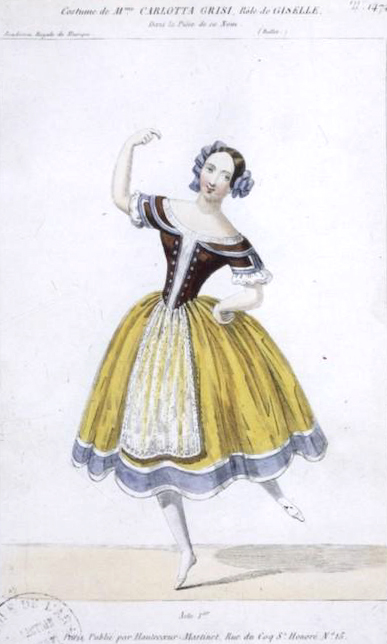
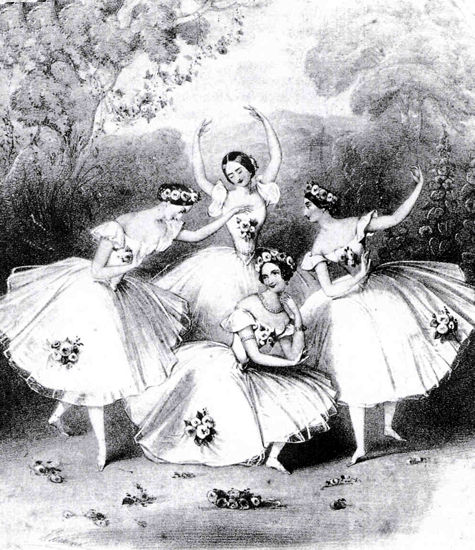
Carlotta Grisi's Birthday - June 28,1819

Carlotta Grisi was an Italian ballet dancer. She was born on June 28, 1819 in Visinada, Istria (now part of Croatia) and died on May 20, 1899 in Saint-Jean, a district of Geneva, Switzerland.


She was trained at the ballet school of Teatro alla Scala in Milan and later with dancer/balletmaster Jules Perrot. At her 1836 debut in London Grisi performed with the accomplished danseur Jules Perrot. She next appeared in Paris at the Théâtre de la Renaissance (1840) and a year later, toured with Perrot to other parts of Europe. Through Perrot's contacts, the pair worked in Paris, London, Vienna, Munich, and Milan where she sang and danced.

Her greatest role however was that of Giselle. The world première of this two-act ballet was on June 28, 1841 at the Theatre de l'Academie Royale de Musique, Paris. The part of Albrecht was danced by Lucien Petipa, (the brother of the great Marius Petipa), with the part of Myrtha, Queen of the Wilis danced by Adele Dumilatre. It caused a sensation and inspired its reviewers to proclaim Giselle to be the greatest ballet of its time and a triumphant successor to the Romantic masterwork La Sylphide. As such, it immediately established Grisi as a star in her very first full-length ballet in Paris. Her salary grew from 5,000 francs to 12,000 in 1842 and 20,000 by 1844, with additional performance fees on top. Grisi's last performance in the west was in Paul Taglioni's Les Métamorphoses (aka Satanella, 1849).


In 1850, she joined Perrot in St. Petersburg, Russia, where he had been appointed balletmaster, and she danced Giselle at the Imperial Bolshoi Kamenny Theatre. The first Giselle in Russia had been danced by Fanny Elssler, and so the initial reaction to Grisi's interpretation of the role was not enthusiastic. However, over time the Russians appreciated her talents. She was Prima Ballerina of the St. Petersburg Imperial Theatres in St. Petersburg from 1850 to 1853, working not only with Perrot but also Joseph Mazilier who staged for her La Jolie Fille de Gand and Vert-Vert especially for her.

In 1854, with her daughter, she left Russia for Warsaw, where she intended to continue dancing, but she became pregnant by Prince Léon Radziwill who then persuaded her to retire from ballet at the height of her fame. Grisi gave birth to her second daughter, Léontine Grisi, and, at the age of 34, settled near Geneva to spend the next forty-six years of her life in peaceful retirement. She died in Saint-Jean, Geneva, Switzerland, on May 20, 1899, a month before her 80th birthday.

Wednesday, May 19, 2010

Prince Igor, Paris Premiere-May 19, 1909

Prince Igor was first performed in St.Petersburg, Russia, in 1890. It is an opera by Alexander Borodin, written in four acts with a prologue. The composer adapted the libretto from the East Slavic epic The Lay of Igor's Host, which recounts the campaign of Russian Prince Igor Svyatoslavich against the invading Polovtsian tribes in 1185. The opera was left unfinished upon the composer's death in 1887 and was edited and completed by Nikolai Rimsky-Korsakov and Alexander Glazunov.

The world premiere of the ballet was given in St. Petersburg on November 4, 1890 at the Mariinsky Theatre. Set designers were Yanov, Andreyev, and Bocharov, while
Lev Ivanov was balletmaster.
Moscow premieres followed later.
The first was given in 1892 by the Russian Opera Society, conducted by Iosif Pribik. The Bolshoi Theatre premiere was given in 1898 and was conducted by Ulrikh Avranek
Other notable premieres were given in Prague in 1899, and in Paris on May 19, 1909, with Sergei Diaghilev's Ballets Russes and Fokine’s choreography. London saw the same production in 1914 conducted by Thomas Beecham.

In 1915, the United States premiere took place at the Metropolitan Opera, but staged in Italian and conducted by Giorgio Polacco.

Monday, May 10, 2010

Ballets Russes' Artist, Leon Bakst's Birthday! May 10th.

Rosenberg Lev Samoylovich, called Bakst, was a painter and a stage designer of Belorussian birth. He was born in Grodno on May 10th 1866 and he died in Paris on December 27, 1924.

He began his professional life as a copyist and illustrator of teaching materials but quickly moved on to illustration of popular magazines. His tastes were influenced and horizons enlarged when he met Alexander Benois and his circle in 1890.

With Benois and Serge Diaghilev, he was a founder of the (Mir Iskusstva) group in 1898 and was largely responsible for the technical excellence of its influential magazine. In 1906 he became a drawing teacher at the Yelizaveta Zvantseva's private school in St Peterburg, where his pupils included Marc Chagall.

Bakst realized his greatest artistic success in the theatre. Making the debut with designs for stage productions at the Hermitage and Alexandrinsky theatres in St Peterburg (1902-1903), he was then commissioned for several works at the Maryinsky theatre (1903-1904). In 1909, he collaborated with Diaghilev in the founding of Ballets Russes, where he acted as artistic director, and his stages designs rapidly brought him international fame.
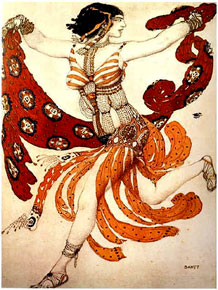
His colorful exotic costumes and decors for Diaghilev's Scheherazade (Paris, 1910) caused a sensation. Between 1909 and 1921 he designed more Diaghilev productions than any other artist; his name became inseparable from the Ballets Russes.

Bakst was an accomplished painter, as well as designer, in the World of Art group. His costumes for Diaghilev’s revival of Imperial Ballet, The Sleeping Princess (London, 1921) was appropriately traditional as may be seen from his Design for Columbine from the ballet (London, Theatre Museum). Other examples of his designs for Diaghilev are to be found in the Australian National Gallery in Canberra.

Wednesday, May 5, 2010

Le Dieu Bleu By Artist Jean Cocteau


Le Dieu Bleu is a one act ballet by Jean Cocteau and Federigo de Madrazo. Fokine was the choreographer and music was by Reynaldo Hahn with décor and costume by Leon Bakst. Le Dieu Bleu premiered May 13, 1912 at Theatre du Chatelet in Paris.


Cocteau wrote the scenario for Ballets Russes’s Le Dieu Bleu after working with Diaghilev since 1911, and designing posters for Spectre de la Rose using portraits of Nijinsky and Karsavina, in 1912. Cocteau and Hahn were inspired by Hindu legends, and Fokine the bas-reliefs of Brahman temples and Siamese dancers. Sadly, Le Dieu Bleu was not successful and removed from the repertoire the following year.

Tuesday, April 27, 2010

Premiere of Narcisse-April 26, 1911

Narcissse is a classical ballet performed in one act. Narcisse premiered on April 26, 1911 at Casino, Monte Carlo. Narcisse was a replacement ballet for Daphnis et Chloe.

Diaghilev had invited Ravel to St. Petersburg, to work with Bakst and Fokine on Daphnis et Chloe. However, Ravel was late in producing the score, and Fokine could not begin the choreography, so Narcisse was done in its place.
Narcisse was originally danced by the legendary Tamara Karsavina, Bronislava Nijinska and Vaslav Nijinsky. In the black & white photo, is Bronislava Nijinska dancing in Narcisse with Fokine's wife Vera Fokina.

The costumes were designed by Leon Bakst, as was the decor. Fokine was the choreographer, and the music was by Nicolas Tcherepnine who also composed Le Pavillon d'Armide.

Sunday, April 25, 2010

A Diaghilev Choreographer: Mikhail Fokine (1880-1942)

Mikhail was born in St. Petersburg on April 25, 1880 and studied at the Imperial School. He graduated at the age of 18, immediately entering the Maryinsky Theatre. He was promoted to soloist in 1904. He started teaching at the Imperial School and choreographed his first ballet, for a student performance, Acia and Galatea in 1905.

Mikhail Fokine is one of, if not the, best known choreographer of the 20th century. His ballets are still performed by ballet companies worldwide. In 1907, he choreographed The Dying Swan for Anna Pavlova, in Carnival of Animals which became her iconic solo. He also created Firebird for Pavlova, but after hearing Stravinsky’s music she refused to dance it, so Tamara Karsavina danced it.

The first ballet Fokine choreographed for the Maryinsky Theatre was Le Pavillon d'Armide. This ballet was included in the repertoire of the first season of Diaghlev's Ballets Russes, in Paris in 1909. He became Diaghlev's chief choreographer, while continuing to dance in Russia until 1918.
Fokine left the Ballets Russes in 1912 because Diaghilev was favoring Vaslav Nijinsky's choreography. He freelanced, finally settling in the United States in 1923. He married Vera Antonova Fokina, they had often been partners in Diaghilev's Ballets Russes. Fokine originally choreographed Chopiniana, to later be renamed Les Sylphides, for a performance outside the Maryinsky in 1907. He restaged Les Sylphides for the then Ballet Theatre's, now ABT, inaugural performance in 1940 at New York's Center Theatre.

Wednesday, April 7, 2010

Picasso; Ballets Russes Artist, Died April 8, 1973

Parade was Picasso's first collaboration with the Ballets Russes and in a letter sent to a friend, Jean Cocteau the librettist said "Picasso amazes me every day, to live near him is a lesson in nobility and hard work" (Rothschild 49). Picasso's studio in Rome had a little crate that held the model of "Parade" with its trees and houses, and on a table were the painted characters: the Chinaman, Managers, American girl, and horse. Cocteau described his friend's unusual artistic process: "A badly drawn figure of Picasso is the result of endless well-drawn figures he erases, corrects, covers over, and which serves him as a foundation. In opposition to all schools he seems to end his work with a sketch." The audiences were amazed by the first ballet to have cubist costumes, sets, and choreography. After World War I, Picasso made a number of important associations and relationships with figures associated with Serge Diaghilev's Ballets Russes. Among his friends during this period were Jean Cocteau, Jean Hugo, Juan Gris and others.


In the summer of 1918, Picasso married Olga Khokhlova, a ballerina with Sergei Diaghilev’s troupe, for whom Picasso was designing a ballet, Parade, in Rome; and they spent their honeymoon in the villa near Biarritz of the glamorous Chilean art patron Eugenia Errázuriz. Khokhlova introduced Picasso to high society, formal dinner parties, and all the social niceties attendant on the life of the rich in 1920s Paris. The two had a son, Paulo, who would grow up to be a dissolute motorcycle racer and chauffeur to his father. Khokhlova’s insistence on social propriety clashed with Picasso’s bohemian tendencies and the two lived in a state of constant conflict. During the same period that Picasso collaborated with Diaghilev’s troup, he and Igor Stravinsky collaborated on Pulcinella in 1920.

Monday, April 5, 2010

Ballets Russes Composer Stravinsky Died April 6th


The most notable of Diaghilev's composers was Igor Stravinsky, who is now recognised as the premier composer of the early twentieth century. Diaghilev had hired the young Stravinsky at a time when he was virtually unknown to compose the music for The Firebird, after the composer Anatoly Lyadov proved unreliable. Diaghilev was thus instrumental in launching Stravinsky's career in Europe and the United States of America.

Stravinsky's early ballet scores were the subject of much discussion. The Firebird (1910) was seen as an astonishingly accomplished work for such a young artist (Debussy is said to have remarked drily: "Well, you've got to start somewhere!"). Many contemporary audiences found Petroushka (1911) to be almost unbearably dissonant and confused. "The Rite of Spring" caused a near-riot by the audience, stunned because of its willful rhythms and aggressive dynamics. The Rite of Spring had to be pulled after just a few performances. The audience's negative reaction to it is now regarded as a theatrical scandal as notorious as the failed runs of Richard Wagner's Tannhäuser at Paris in 1861 and Jean-Georges Noverre's and David Garrick's Chinese Ballet at London on the eve of the Seven Years' War. However, Stravinsky's early ballet scores are now widely considered masterpieces of the genre. Even his later ballet scores (such as Apollo), while not as startling, were still superior to most ballet music of the previous century.

Diaghilev commissioned many other original scores, as well as borrowing freely from the existing musical canon. His ballets variously included music by Debussy, Milhaud, Poulenc, Prokofiev, Ravel, Satie, Respighi, and Richard Strauss.

Friday, March 19, 2010

Sergei Pavlovich Diaghilev: Birthday


Sergei Diaghilev was born March 19, 1872, in Perm, Russia, into a wealthy noble family of Novgorod, Russia. His father, named Pavel Diaghilev, was a distinguished General to the Russian Tsar Nicholas II. His mother died at his birth. Young Sergei Diaghilev grew up in a highly cultured environment. He studied piano and singing from the early age. He also took lessons in painting at the St. Petersburg Academy of Arts, and studied music with Nikolai Rimsky-Korsakov at the St. Petersburg Conservatory. From 1891-1896 Diaghilev studied law and graduated from the Law Department of the St. Petersburg University. There he developed a life-long friendship with his fellow law student Alexandre Benois. As a law student he came to St. Petersburg where he became co-founder of the progressive art magazine Mir Iskusstva (The World of Art) in 1899. The same year he was appointed artistic adviser of the Maryinsky Theatre. He resigned this post in 1901 and when the magazine stopped publishing in 1904, he concentrated on organizing exhibitions of Russian art in St. Petersburg and Paris. In 1908 he brought a production of "Boris Godunov" to Paris, with the famous singer, Feodor Chaliapin.

In 1909 he brought to Paris a season of opera and ballet and, with the best dancers from the Maryinsky, he scored a great success. Repeat visits in the following years resulted in the formation of the Ballets Russes in 1911 as an independent private company, which he directed until his death in 1929. He never returned to Russia after the 1917 revolution. In fact, Diaghilev's Ballets Russes never performed in Russia. Prior to 1909 most ballet companies were a part of an opera company or were subsidized by the court or the ruling power. The Paris Opera was the home of the ballet, even in Russia the ballet was part of the opera. In 1909 when Diaghilev decided to bring a small company of dancers to Paris he did this by bringing the great opera star Chaliapin to share the program. Both people in Russia and Paris thought that he was crazy. Diaghilev didn't had an easy time getting enough money to get the this project to Paris. Once he accomplished the first season in Paris he had to do this during the dancers yearly time off. He had to get them back to St. Petrersburg before their season started.

Diaghilev collaborated with the most famous artists, composers and dancers of the period. Artists like Alexandre Benois, Leon Bakst, Nicolas Roerich, Pablo Picasso, Henri Matisse. He got composers such as Igor Stravinsky, Sergei Prokofiev, Maurice Ravel, Claude Debussey and Erik Satie to name a few, to compose new music for the ballet. He encouraged Mikhail Fokine, Vaslav Nijinsky, Leonide Massine, Bronislava Nijinska and George Balanchine to choreograph new ballets for the company.

Diaghilev never went to sleep without thinking of some way to get enough money to spawn a new ballet. After his death in 1929 the company that he had worked so hard to create disbanded. It took until 1933 before another company could get the funding and leadership to start a new season, using many of the dancers that had been with Diaghilev's Ballets Russes.

Monday, March 8, 2010

Cleopatra Premiere's March 8, 1908

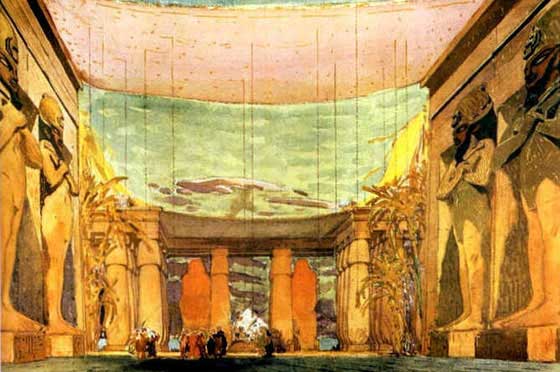
Cleopatra was first performed at a benefit in St. Petersburg at the Maryinsky Theatre on March 8, 1908. It was called Nuit d"Egypte at that time. It was originally staged and choreographed by Fokine, solely to Arensky's score. Most of the costumes that were used were borrowed from La Fille du Pharaon and Aida, only soloist costumes were sketched by Leon Bakst. The set came from one of the operas in the Maryinsky's repertoire, but was touched up by Maryinsky stage designer, Oreste Allegri.

On June 2,1909, Diaghilev's Ballets Russes performed it as Cleopatra at the Theatre du Chatelet as part of their first season in Paris. Fokine talked Diaghilev into using a student of his, a non-professional dancer, for the part of Cleopatra, Ida Rubinstein. The sets and costumes were designed by Leon Bakst a the suggestion of Alexandre Benois.


In 1917, while on their Latin American tour, the set for Cleopatra was destroyed in a fire; in July 1918 Diaghilev ordered a new set to be designed by Robert Delauney. He ordered sketches of the costumes for Lubov Tchernicheva and Leonide Massine, from Delauney's wife Sonia.

After attending the opening night of Cleopatra's debut in Berlin, Kaiser Wilhelm II, urged members of his Society of Egyptology to study Bakst's mise-en-scene.


Wednesday, January 20, 2010

Sonia: Picasso Was My Godfather

Dear Balletomanes:

December 17, 2009 marked the birthday of someone truly special, Sonia Wojcikowska. Who is Sonia, you ask? Sonia is the daughter of two of Diaghilev's original Ballets Russes dancers, Helena Antonova (photo with shawl) and Leon Wojcikowski (portrait below), and she was the God-daughter of Picasso. Sonia was an accomplished ballerina, who was a member of the Ballets Russes.

I myself only met Sonia once, and she left quite an impression. I am told that these days, she prefers to watch the New York Yankees, a big fan I understand - good taste. Apparently, due to some difficult times, Sonia chooses not to share her memories of her Ballets Russes years. While I respect that, as they are her stories to tell or not tell, it is a shame for us, as hers are stories that will now never be told, a book we'd like to read, but one she doesn't want to write.

Sonia was born December 17, 1919. Sonia was educated at the Lycee Jules Ferrier school in Paris under Lubov Egorova. Sonia started her career as a little girl in a walk-on part in Diaghilev’s Ballets Russes production of Petrouchka holding the hand of Enrico Cecchetti. Sonia’s parents, Helena Antonova and Leon Wojcikowski, were both stars of Diaghilev’s Ballets Russes company. Sonia’s godfather was Pablo Picasso.

At 9, Sonia sang the part of Chaliapin’s grand-daughter in Opera La Sirene, (The Mermaid) at Paris Opera. Later she sang two Spanish songs off-stage for Leonide Massine’s Three Cornered Hat. When Sonia was thirteen she danced with her mother at the Paris Opera with Les Ballets Ida Rubinstein. Sonia danced many of her mother's roles. (Her father told her once that he could not tell them apart.) By replacing Nathalie Krassovska in Rubinstein's company Sonia danced her first solo in Mikhail Fokine's Diane de Poitiers.

If you scroll down on my Russian Ballet History website Blog page, there is a copy of a Dance Magazine article on Sonia from June, 1963. Click here to read it!

Sonia joined Mme. Egorova’s Ballet de la Jeunesse at 14 years of age. She later became a soloist with the Original Ballet Russse in 1938. Sonia first came to the United States on the Normandie to dance in the World’s Fair in 1939. In 1940 she became a soloist with Ballet Theatre, now American Ballet Theatre in New York City. Sonia also had a part in the original “Oklahoma” and was the “Foxhole Ballerina” for the troops in WWII. Sonia became a US citizen in 1949. She married violinist Joska de Barbary and still resides in New York City. She is 90 years old this year, or more appropriately 90 years young!


Curtsy, Bow, Acknowledge the Orchestra,


Stacey