Sergei Diaghilev was born March 19, 1872, in Perm, Russia, into a wealthy noble family of Novgorod, Russia. His father, named Pavel Diaghilev, was a distinguished General to the Russian Tsar Nicholas II. His mother died at his birth. Young Sergei Diaghilev grew up in a highly cultured environment. He studied piano and singing from the early age. He also took lessons in painting at the St. Petersburg Academy of Arts, and studied music with Nikolai Rimsky-Korsakov at the St. Petersburg Conservatory. From 1891-1896 Diaghilev studied law and graduated from the Law Department of the St. Petersburg University. There he developed a life-long friendship with his fellow law student Alexandre Benois. As a law student he came to St. Petersburg where he became co-founder of the progressive art magazine Mir Iskusstva (The World of Art) in 1899. The same year he was appointed artistic adviser of the Maryinsky Theatre. He resigned this post in 1901 and when the magazine stopped publishing in 1904, he concentrated on organizing exhibitions of Russian art in St. Petersburg and Paris. In 1908 he brought a production of "Boris Godunov" to Paris, with the famous singer, Feodor Chaliapin.
 In 1909 he brought to Paris a season of opera and ballet and, with the best dancers from the Maryinsky, he scored a great success. Repeat visits in the following years resulted in the formation of the Ballets Russes in 1911 as an independent private company, which he directed until his death in 1929. He never returned to Russia after the 1917 revolution. In fact, Diaghilev's Ballets Russes never performed in Russia. Prior to 1909 most ballet companies were a part of an opera company or were subsidized by the court or the ruling power. The Paris Opera was the home of the ballet, even in Russia the ballet was part of the opera. In 1909 when Diaghilev decided to bring a small company of dancers to Paris he did this by bringing the great opera star Chaliapin to share the program. Both people in Russia and Paris thought that he was crazy. Diaghilev didn't had an easy time getting enough money to get the this project to Paris. Once he accomplished the first season in Paris he had to do this during the dancers yearly time off. He had to get them back to St. Petrersburg before their season started.
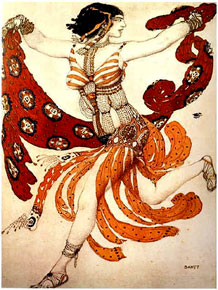
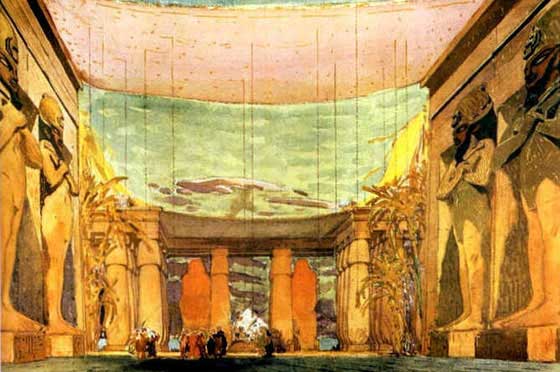
Diaghilev collaborated with the most famous artists, composers and dancers of the period. Artists like Alexandre Benois, Leon Bakst, Nicolas Roerich, Pablo Picasso, Henri Matisse. He got composers such as Igor Stravinsky, Sergei Prokofiev, Maurice Ravel, Claude Debussey and Erik Satie to name a few, to compose new music for the ballet. He encouraged Mikhail Fokine, Vaslav Nijinsky, Leonide Massine, Bronislava Nijinska and George Balanchine to choreograph new ballets for the company.
Diaghilev never went to sleep without thinking of some way to get enough money to spawn a new ballet. After his death in 1929 the company that he had worked so hard to create disbanded. It took until 1933 before another company could get the funding and leadership to start a new season, using many of the dancers that had been with Diaghilev's Ballets Russes.