Diaghilev's Ballets Russes

Diaghilev's Ballets Russes
1909-1929

Welcome Balletomanes

This Blog is dedicated to preserving and celebrating the history and memories of Diaghilev's Ballets Russes, its legendary ballet dancers, choreographers, scenery artists, musicians and composers.
Showing posts with label Fokine. Show all posts

Monday, December 19, 2011

Premiere of Dying Swan-December 22, 1905

The Dying Swan (originally The Swan) is a ballet choreographed by Mikhail Fokine in 1905 to Camille Saint-Saëns's cello solo Le Cygne from Le Carnaval des Animaux as a pièce d'occasion for the ballerina Anna Pavlova.


The short ballet follows the last moments in the life of a swan, and was first presented in St. Petersburg, Russia in 1905. Inspired by swans that Anna Pavlova had seen in public parks and Alfred, Lord Tennyson's poem "The Dying Swan", Anna Pavlova asked Michel Fokine, who had also read the poem, to create a solo ballet for her for a 1905 concert being given by artists from the chorus of the Imperial Mariinsky Opera.

Thursday, September 16, 2010

Alexandre Volinine's Birthday Today-September 16, 1882

Alexandre Volinine was born in Moscow on September 16, 1882. He was a Russian-French dancer and teacher. Volinine studied at the Bolshoi Ballet School, with Tikhomirov and Gorsky and he graduated in 1901. After graduating, he was invited to join the Bolshoi Ballet and was quickly promoted to principal danseur in 1903. Volinine created roles in Gorsky's Robert and Bertram (1906) and Nur and Anitra (1907), and danced all the leading male roles in the classical repertoire.

He left the Bolshoi in 1910, first dancing with Diaghilev's Ballets Russes in the 1910 Paris season. It was here that he danced a Principal role in Fokine's Les Orientales, and then toured with Lydia Lopokova (1910-11) in America. He appeared with Gertrude Hoffmann's so-called Ballets Russes at the Winter Garden Theater in New York in 1911 and with Mikhail Mordkin's All-Star Imperial Russian Ballet (1911-12). Later Volinine partnered Adeline Genée on tour to America, Australia, and New Zealand (1912-13); also partnered Lydia Kyasht at the Empire Theatre in London in 1913.


Volinine most famous partner was Anna Pavlova. He danced with Anna Pavlova's company on its various world tours from 1914 to 1925, partnering Pavlova and creating the role of the Young Poet in her Autumn Leaves (1919).
In 1926, having retired from the stage, he opened a famous school in Paris, where his students included Babilée, Eglevsky, Jeanmaire, and Lichine. In 1946 he staged Giselle for the Royal Danish Ballet.

Tuesday, September 14, 2010

Olga Alexandrovna Spessivtzeva Born 9/16,1895

Olga was born in Rostov-on-Don, Russia. She was the daughter of an opera singer. After her father's death, she was sent to an orphanage in St. Petersburg with theatrical connections. She entered St. Petersburg's Imperial Ballet Academy in 1906, where she was a student of Klavdia Kulichevskaya and later of Agrippina Vaganova. After graduating in 1913, Olga joined the Mariinsky Theater, where she was promoted to Soloist in 1916. An exquisite romantic dancer with perfect technique, ideally suited for roles such as Giselle and Odette-Odile in Swan Lake, she quickly became one of the most admired dancers in the company.

In 1916, Diaghilev invited her to tour with his Ballets Russes in the United States. Olga danced with Nijinsky in Le Spectre de la Rose, Les Sylphides and the Bluebird pas de deux from Sleeping Beauty. In 1918 she returned to the Mariinsky, and was promoted to Ballerina.

In 1921, Olga performed with Diaghilev’s Ballets Russes as Aurora, in his revived The Sleeping Princess in London. She continued to perform with the Ballets Russes abroad, at the Teatro Colón in Buenos Aires in 1923. With the aid of her ex-husband Boris Kaplun, she left Russia for the last time in 1924, accepting an invitation to dance as an étoile (prima ballerina) at the Paris Opera Ballet, where she remained until 1932.

In 1932, Olga made another memorable guest appearance in London, dancing Giselle with Anton Dolin. From 1932 to 1937, she toured with a number of companies throughout the world, performing roles from both the classical repertoire and contemporary ballets by choreographers such as Michel Fokine and Bronislava Nijinska. In 1939, Olga moved to the United States where she taught and served as an advisor to the Ballet Theatre Foundation.

Olga suffered a nervous breakdown in 1943, and she was hospitalized. She remained institutionalized until 1963 when, with the help of her friends Anton Dolin and Felia Doubrovska, she was discharged and settled in Valley Cottage on the Tolstoy Farm. The Tolstoy Farm is a Russian community run by the Tolstoy Foundation in New York's Rockland County. It was founded by Countess Alexandra Tolstoy, daughter of the novelist, as a rest home for Russians. Recovered, she lived there in peaceful retirement for nearly three decades, dying at the age of 96.

Monday, June 28, 2010

Anniversary of Serge Grigoriev's Passing


Serge Grigoriev was born October 5, 1883 in Russia and died in London on June 28, 1968. He studied at the St. Petersburg Imperial School, graduating in 1900, and danced with the Maryinsky Ballet until Diaghilev appointed him ballet master in 1909. Serge Grigoriev danced the classic ballets from the repertory of Diaghilev's Ballets Russes.


He became régisseur of the Ballets Russes on their first trip to Paris in 1909 and remained in that position for twenty years. Grigoriev was a friend of Mikhail Fokine, and Fokine recommended him to rehearse the ballets for the 1909 season. As a dancer he created the role of Shah Shariar in Fokine's Scheherazade (1910), Guidone in Fokine's Le Coq d'or (1914), and the Russian Merchant in Massine's La Boutique Fantasque (1919). Fokine however, left the Ballets Russes over issues with Nijinsky, but Grigoriev stayed.


After Diaghilev fired Vaslav Nijinsky he needed to rehire Fokine. Before he agreed to return, Fokine made many demands: to dance leading roles; that all of Nijinsky's ballets be dropped from the repertoire; and that Grigoriev and his wife, the ballerina Lubov Tchernicheva, be discharged from the company. He got everything but the termination of Grigoriev. Diaghilev got Fokine, Grigoriev and Tchernicheva to reconcile. Grigoriev remained with Diaghlev’s Ballets Russes until the death of Serge Diaghilev.

After the death of Diaghilev in 1929, the company disbanded; Grigoriev and his wife joined Colonel de Basil's Ballet Russe in 1932, restaging the original choreography of Diaghilev's repertoire and remaining until 1948. Working with his wife, Lubov Tchernicheva, he produced several Fokine revivals for Sadler's Wells/Royal Ballet: Firebird (1954), Les Sylphides (1955), and Petrushka (1957) and the Polovtsian Dances from Prince Igor (1965).

Thursday, June 24, 2010

The Firebird - Premiered June 25, 1910


The Firebird is a 1910, neoclassical ballet with music by Igor Stravinsky and choreography by Michel Fokine. The ballet is based on Russian folk tales of the magical glowing bird of the same name that is both a blessing and a curse to its captor.


The music premiered as a ballet by Diaghilev's Ballets Russes in Paris on June 25, 1910 conducted by Gabriel Pierné. It was the first of their productions with music specially composed for them. Originally the music was to have been written by Russian composer Anatol Liadov but when he was slow in starting to compose the work, Diaghilev transferred the commission to the 28-year old Stravinsky. The ballet has historic significance not only as Stravinsky's 'breakthrough piece, but also as the beginning of the collaboration between Diaghilev and Stravinsky. They would later produce Petrushka and The Rite of Spring.


Firebird was to originally be danced by Anna Pavlova, but when she heard Stravinsky’s music she declared it “noise” and refused to dance to it. Tamara Karsavina was given the iconic role.

Tuesday, June 8, 2010

Daphnis Et Chloe - Premiered June 8, 1912

Daphnis et Chloe is a choreographic symphony in one act and three scenes, by Michel Fokine and Maurice Ravel. The décor and costumes were done by Leon Bakst. Daphnis et Chloe premiered at Theatre de Chatelet in Paris on June 8, 1912.

Maurice Ravel accepted a commission from Diaghilev to write Daphnis et Chloe, in 1909. He was slow to deliver, so Diaghilev sent him to St. Petersburg to work with Fokine and Bakst. The three men got along so well that it just extended the creative process and Ravel did not finish Daphnis et Chloe until 1912.
The idea itself for adapting the Longus pastoral tale for the stage was Fokine’s. His friend Isadora Duncan had influenced his interest in ancient Greece. The ballet was originally scheduled for the 1911 repertoire, but Narcisse was substituted when Daphnis et Chloe was not yet finished. When rehearsals for Daphnis et Chloe finally began in 1911, Diaghilev was completely distracted by Nijinsky’s L’Apres-Midi and Diaghilev’s lack of interest in Daphnis et Chloe was said to be the main reason for Fokine leaving the Ballets Russes Company in June of 1912, right after its premiere.
A few years later, in 1919, Ravel was commissioned again by Diaghilev to do La Valse, but they disagreed on the scenic concept, that topped with Massine’s departure led Diaghilev to abandon the ballet’s production. Ravel was so stunned by Diaghilev’s behavior that years later they ran into one another in the lobby of the Hotel de Paris in Monte Carlo, and Ravel would not shake hands with Diaghilev.

Tuesday, April 27, 2010

Premiere of Narcisse-April 26, 1911

Narcissse is a classical ballet performed in one act. Narcisse premiered on April 26, 1911 at Casino, Monte Carlo. Narcisse was a replacement ballet for Daphnis et Chloe.

Diaghilev had invited Ravel to St. Petersburg, to work with Bakst and Fokine on Daphnis et Chloe. However, Ravel was late in producing the score, and Fokine could not begin the choreography, so Narcisse was done in its place.
Narcisse was originally danced by the legendary Tamara Karsavina, Bronislava Nijinska and Vaslav Nijinsky. In the black & white photo, is Bronislava Nijinska dancing in Narcisse with Fokine's wife Vera Fokina.

The costumes were designed by Leon Bakst, as was the decor. Fokine was the choreographer, and the music was by Nicolas Tcherepnine who also composed Le Pavillon d'Armide.

Sunday, April 25, 2010

A Diaghilev Choreographer: Mikhail Fokine (1880-1942)

Mikhail was born in St. Petersburg on April 25, 1880 and studied at the Imperial School. He graduated at the age of 18, immediately entering the Maryinsky Theatre. He was promoted to soloist in 1904. He started teaching at the Imperial School and choreographed his first ballet, for a student performance, Acia and Galatea in 1905.

Mikhail Fokine is one of, if not the, best known choreographer of the 20th century. His ballets are still performed by ballet companies worldwide. In 1907, he choreographed The Dying Swan for Anna Pavlova, in Carnival of Animals which became her iconic solo. He also created Firebird for Pavlova, but after hearing Stravinsky’s music she refused to dance it, so Tamara Karsavina danced it.

The first ballet Fokine choreographed for the Maryinsky Theatre was Le Pavillon d'Armide. This ballet was included in the repertoire of the first season of Diaghlev's Ballets Russes, in Paris in 1909. He became Diaghlev's chief choreographer, while continuing to dance in Russia until 1918.
Fokine left the Ballets Russes in 1912 because Diaghilev was favoring Vaslav Nijinsky's choreography. He freelanced, finally settling in the United States in 1923. He married Vera Antonova Fokina, they had often been partners in Diaghilev's Ballets Russes. Fokine originally choreographed Chopiniana, to later be renamed Les Sylphides, for a performance outside the Maryinsky in 1907. He restaged Les Sylphides for the then Ballet Theatre's, now ABT, inaugural performance in 1940 at New York's Center Theatre.

Monday, March 8, 2010

Cleopatra Premiere's March 8, 1908

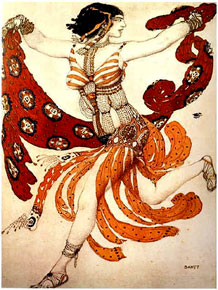
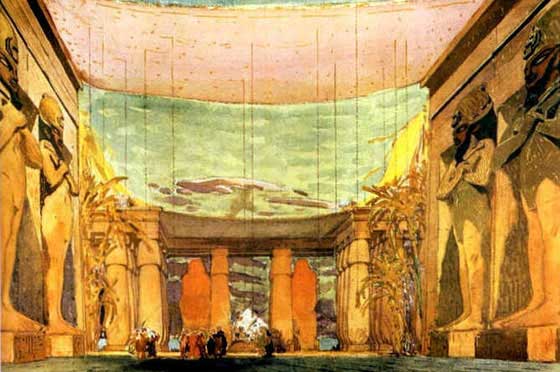
Cleopatra was first performed at a benefit in St. Petersburg at the Maryinsky Theatre on March 8, 1908. It was called Nuit d"Egypte at that time. It was originally staged and choreographed by Fokine, solely to Arensky's score. Most of the costumes that were used were borrowed from La Fille du Pharaon and Aida, only soloist costumes were sketched by Leon Bakst. The set came from one of the operas in the Maryinsky's repertoire, but was touched up by Maryinsky stage designer, Oreste Allegri.

On June 2,1909, Diaghilev's Ballets Russes performed it as Cleopatra at the Theatre du Chatelet as part of their first season in Paris. Fokine talked Diaghilev into using a student of his, a non-professional dancer, for the part of Cleopatra, Ida Rubinstein. The sets and costumes were designed by Leon Bakst a the suggestion of Alexandre Benois.


In 1917, while on their Latin American tour, the set for Cleopatra was destroyed in a fire; in July 1918 Diaghilev ordered a new set to be designed by Robert Delauney. He ordered sketches of the costumes for Lubov Tchernicheva and Leonide Massine, from Delauney's wife Sonia.

After attending the opening night of Cleopatra's debut in Berlin, Kaiser Wilhelm II, urged members of his Society of Egyptology to study Bakst's mise-en-scene.


Friday, January 22, 2010

The Passing of Anna Pavlova: The Beauty of a Swan

Dear Balletomanes,

On January 23rd of 1931, the world lost Anna Pavlova. Anna contracted double pneumonia on a train en route to Haage, and her condition deteriorated rapidly. She died in the early hours, in Haage, Netherlands. Her remains were moved to the Novodevichy Convent Cemetery in Moscow, Russia in 2001. (photo right)

Anna was not a typical ballerina of her day. At only five-feet-tall, she was delicate and slender, unlike most of the students in her classes. She was exceptionally strong and had perfect balance. Anna was known to have had very arched feet, which made it hard to dance on the tips of her toes. She discovered that by adding a piece of hard leather to the soles, the shoes provided better support. At that time, many people thought of this as cheating, since a ballerina was to be able to hold her own weight on her toes. Anna’s idea was the precursor to the modern pointe shoe.

Anna Pavlova was born on February 12th in St. Petersburg, Russia in 1881. And at the age of 10 she began to study at the Imperial Ballet School. Her early teachers were Nicolai and Sergei Legat, Yekaterina Vazem, Pavel Gerdt, and her favorite teacher, and mentor until her death, Enrico Cecchetti. Pavlova's style and poetic way of moving attracted attention even as a student. After her graduation in 1902 she joined the Maryinsky Theatre as second soloist and was promoted to first soloist the following year. With Cecchetti's help she was promoted to Ballerina in 1905, and Prima Ballerina in 1906.

In 1907, Anna Pavlova began her first tour, to Moscow. On her second foreign tour in 1909, she joined Diaghilev's Ballet Russes in Paris where she danced The Dying Swan choreographed for her by Fokine with music from Saint-Saen's Carnival of the Animals. Fokine then had her in mind when he choreographed The Firebird, but when she heard Igor Stravinsky's music she pronounced it nonsense and refused to dance to it. The role went to Tamara Karsavina.

On February 28, 1910, after leaving the Ballets Russes, she appeared at the Metropolitan Opera House in New York. She danced Swanilda in Coppelia, partnered by Mikhail Mordkin. Later that year, Pavlova formed her own company, with eight dancers from St. Petersburg. In the Fall of 1911, she returned to London to take part in Diaghilev's Fall season at Covent Garden. Partnered by Nijinsky, she danced in Giselle, Le Pavillon d'Armide, Cleopatre, Le Carnaval, and a pas de deux billed as L'Oiseau d'Or. The Pavlova/Nijinsky partnership was an amazing one, but short-lived. Pavlova would never again dance with Nijinsky or appear with the Diaghilev company. Immediately after the London season, she undertook her first tour of her English provinces, partnered by Novikoff and supported by a small group of Soloists from the Imperial Ballet. Anna remained a member of the Maryinsky Theatre until 1913, when she made her last appearance in St. Petersburg.

She spent the rest of her life on tour. In 1914, she was traveling through Germany on her way to England when Germany declared war on Russia, her connection to Russia was for all intents broken. Pavlova toured all over the world including Europe, Asia, North and Central America, and Australia. Anna was able to make eight to nine performances per week and had great interest in performing for inexperienced audiences across the world. Her performances in Mexico, India, Japan and Australia were legendary. She was overworked and exhausted by her late 40's, but still danced vigorously. She gave over four thousand ballet performances during the years between 1913-1930 travelling over a total of 300,000 miles.
In 1921 she bought Ivy House in England and opened her own School of Dance. From then on she spent the rest of her career on tour, bringing ballet to millions for the first time. Her last world tour was in 1928-29 and her last performance in England in 1930. Later, Anna Pavlova appeared in a few silent films: one, The Immortal Swan, she shot in 1924 but it was not shown until after her death -- it originally toured theaters in 1935-1936 in special showings, then was released more generally in 1956.

She once said "If I can't dance then I'd rather be dead." Her final words were, "Get my swan costume ready, then play that last measure softly." In keeping with old ballet tradition, on the day she was to have next performed, the show went on as scheduled, with a single spotlight circling an empty stage where she would have been.
Anna's birthday is coming up next month and I will post more information about her, so make sure to check back in February to read more!

Curtsy, Bow and Acknowledge the Orchestra,

Stacey