Diaghilev's Ballets Russes

Diaghilev's Ballets Russes
1909-1929

Welcome Balletomanes

This Blog is dedicated to preserving and celebrating the history and memories of Diaghilev's Ballets Russes, its legendary ballet dancers, choreographers, scenery artists, musicians and composers.

Tuesday, March 16, 2010

Irina Baronova: Baby Ballerina's Birthday!

Irina Baronova was one of the three famous "Baby Ballerinas" along with Tatiana Riabouchinska and Tamara Toumanova. She was born in Petrograd in 1919 and moved to Paris during childhood. There she studied with Olga Preobrajenska and made her debut with the Paris Opera in 1930. George Balanchine noticed Irina as he watched classes and engaged her at age 13 for the Ballets Russes de Monte Carlo in 1932.


She created roles in Leonide Massine's Les Présages, Jeux d'enfants, Beau Danube, and Bronislava Nijinska's Les cent baisers. In 1940 she joined Ballet Theatre and she married Gerry Sevastianov, one of the directors. In 1946, Baronova married Cecil Tennant with whom she had three children, Victoria, Irina and Robert.


Baronova also appeared in films and musicals, was a guest artist with the Original Ballet Russe and was an active member of the Royal Academy of Dancing. She wrote an article called "Dancing for de Basil" for About the House (a magazine about the Royal Opera House at Covent Garden) in 1964. In 1974, she returned to ballet as a teacher and consultant. In 2005, she wrote her autobiography, Irina: Ballet, Life and Love. She passed away at her home in Australia on June 28, 2008 at the age of 89.


Igor Youskevitch: Ballet's Birthday Boy

Igor Youskevitch's birthday was March 13th. He was the son of a judge in a small Ukrainian community near Kiev. After escaping the Bolshevik Revolution in 1920, his family settled in Belgrade, Yugoslavia.


Igor he made his ballet debut in Paris in 1932. He remained in Paris and continued his studies with Olga Preobrajenska for the next two years. In 1934 Youskevitch joined Bronislava Nijinska's Les Ballets de Paris, and in 1935 he became a member of Leon Woicikowski's ballet. Colonel de Basil sponsored Woicikowski's tour of Australia starring Igor Youskevitch and André Eglevsky in 1937. While with the Woicikowski's Ballet ,Youskevitch met Anna Scarpova, a dancer with the company, and they were married in 1938. That same year, Youskevitch and Scarpova became members of the Ballet Russe de Monte Carlo. He remained there until he volunteered to served in the U.S. Navy in 1944.


In 1946, he joined Leonide Massine's Ballet Russe Highlights, and that fall he became a premier danseur of Ballet Theatre, now American Ballet Theatre. While with ABT he and Alicia Alonso (created roles in George Balanchine's Theme and Variations in 1947. As a team they became world renowned, and in 1948 he was guest artist with Alonso's Cuban Ballet. Youskevitch created a role in Antony Tudor's Shadow of the Wind in 1948 and he danced in Gene Kelly's movie Invitation to the Dance in 1952.

After leaving ABT in 1955, Igor returned with Alonso to star for Ballet Russe de Monte Carlo. Igor Youskevitch won the Dance Magazine Award in 1958, In 1960 he rejoined Ballet Theatre as a Guest Artist on their first visit to the Soviet Union.


He retired from the stage in 1962, but not from dance. Youskevitch was on the faculty of the University of Texas in Austin from 1971 to 1982. He co-founded the New York International Ballet Competition in 1985, and he remained its Artistic Director until his death. He was awarded the Capezio Dance Award in 1991 and passed away in 1994.

Thursday, March 11, 2010

Nijinsky's Birthday!

Vaslav Nijinsky was born in Kiev, Russia, March 12, 1888. He entered the Imperial School in St. Petersburg in 1898, and upon graduation in 1907 became a soloist with the Maryinsky Theatre. He met Sergei Diaghilev, and Nijinsky went to Paris with him to dance the leading roles in Le Pavillion d'Armida and Les Sylphides with Pavlova in 1909. The next year he danced the golden slave in Scheherazade.

He continued to dance with Diaghilev's Ballets Russes after 1909, even though Anna Pavlova left because Diaghilev favored his male dancers. Although Vaslav danced with many great ballerinas, he was most associated with Tamara Karsavina, with whom he danced in 1911 in one of the most famous ballets of the time, Le Spectre de la Rose.

Nijinsky’s choreography broke away from his classical training. His ballets were controversial, his Jeux made headlines in the morning press, and Le Sacre du Printemps had the audiences shouting obscenities in the theater and on the streets of Paris.

In 1913, the Ballets Russes toured South America, and because of his fear of ocean voyages Diaghilev did not accompany them. Without his mentor's supervision Nijinsky fell in love with Romola de Pulszky, a Hungarian dancer. They were married in Buenos Aires: when the company returned to Europe, Diaghilev, in a jealous rage, fired them both.

During World War I Nijinsky, a Russian citizen, was interned in Hungary. Diaghilev succeeded in getting him out for a North American tour in 1916, during which he choreographed and danced the leading role in Till Eulenspiegel. Signs of his dementia praecox were becoming apparent to members of the company. He became afraid of other dancers and that a trap door would be left open.

Nijinsky spent may years in and out of mental hospitals. In 1947 the family moved to London, where he was cared for by his loving wife, Romola, until his death in 1950. He is buried in Paris at the Sacre Coeur cemetery.

Monday, March 8, 2010

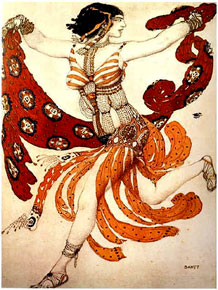
Cleopatra Premiere's March 8, 1908

Cleopatra was first performed at a benefit in St. Petersburg at the Maryinsky Theatre on March 8, 1908. It was called Nuit d"Egypte at that time. It was originally staged and choreographed by Fokine, solely to Arensky's score. Most of the costumes that were used were borrowed from La Fille du Pharaon and Aida, only soloist costumes were sketched by Leon Bakst. The set came from one of the operas in the Maryinsky's repertoire, but was touched up by Maryinsky stage designer, Oreste Allegri.

On June 2,1909, Diaghilev's Ballets Russes performed it as Cleopatra at the Theatre du Chatelet as part of their first season in Paris. Fokine talked Diaghilev into using a student of his, a non-professional dancer, for the part of Cleopatra, Ida Rubinstein. The sets and costumes were designed by Leon Bakst a the suggestion of Alexandre Benois.


In 1917, while on their Latin American tour, the set for Cleopatra was destroyed in a fire; in July 1918 Diaghilev ordered a new set to be designed by Robert Delauney. He ordered sketches of the costumes for Lubov Tchernicheva and Leonide Massine, from Delauney's wife Sonia.

After attending the opening night of Cleopatra's debut in Berlin, Kaiser Wilhelm II, urged members of his Society of Egyptology to study Bakst's mise-en-scene.


Monday, March 1, 2010

Ballets Russes' March Birthday Girls

Tamara Toumanova was born March 2, 1919 to Georgian parents, on a train while her mother was trying to flee during the Russian Revolution. The family eventually settled in Paris. She studied ballet with Olga Preobrajenska. Tamara made her debut at the Paris Opera at the age of nine in L'Eventail de Jeanne. Tamara was one of the three “Baby Ballerinas”. George Balanchine saw her in ballet class and signed her to the Ballets Russes de Monte Carlo at the age of 13. Balanchine choreographed the part of the Young Girl for Tamara in his ballet Cotillon, Concurrence and Le Bourgeois Gentilhomme and Le Palais de Cristal (now Symphony in C).
Tamara was a guest artist with the American Ballet Theatre 1944-45, the Paris Opéra Ballet 1947 and 1950, De Cuevas Company 1949, La Scala 1951 and 1952, London Festival Ballet 1952 and 1954. She passed away in Santa Monica, California, on May 29, 1996.


Irina Baronova was born in St. Petersburg on March 13, 1919. Irina Baronova was one of the three famous "Baby Ballerinas" along with Tatiana Riabouchinska and Tamara Toumanova. She moved to Paris during childhood. There she studied with Olga Preobrajenska and made her debut with the Paris Opera in 1930. George Balanchine noticed Irina as he watched classes and engaged her at age 13 for the Ballets Russes de Monte Carlo in 1932.
She created roles in Leonide Massine's Les Présages, Jeux d'enfants, Beau Danube, and Bronislava Nijinska's Les Cent Baisers. In 1940, she joined Ballet Theatre, now ABT, as prima ballerina. Irina also appeared in films and musicals, was a guest artist with the Original Ballet Russe and was an active member of the Royal Academy of Dancing.


Lydia Sokolova was born March 4, 1886 as Hilda Munnings. She was Diaghilev's first English ballerina. Lydia received much of her training from London's Stedman Ballet Academy, Anna Pavlova, Mikhail Mordkin, and Enrico Cecchetti. She joined Diaghilev’s Ballets Russes company in 1913 and remained until Diaghilev died in 1929. Lydia danced every sort of role from classical to comedy. Her most famous role was that of the Chosen Maiden in Leonide Massine's revival of Le Sacre du Printemps in 1920. She also danced the lead in Massine's Le Tricorne.
When Diaghilev died many dancers had to find other employment. Lydia choreographed some London musicals and in 1935 she danced in Leon Woizikovsky's Company. She also danced in the Royal Ballet production of Massine's The Good-Humoured Ladies in 1962.
Suggested reading, book by Lydia Sokolova. Dancing for Diaghilev.

Friday, February 19, 2010

100th Anniversary of Carnaval: Ballet by Fokine


Carnaval is a ballet based on the music of Robert Schumann's, Carnaval, for piano. It was orchestrated by Aleksandr Glazunov, Nikolai Rimsky-Korsakov, Anatole Liadov, Alexander Tcherepnin. Carnaval was choreographed by Ballets Russes’ Mikhail Fokine, with the costumes designed by Léon Bakst. Fokine created Carnaval for a benefit given in St. Petersburg, Russia and it premiered on February 20, 1910.

Some of the leading dancers of the Imperial Ballet were cast in Carnaval: Tamara Karsavina (Columbine), Leonid Leontiev (Harlequin), Vera Fokina (Charina), Ludmila Schollar (Estrella), Bronislava Nijinska (Papillon), Vsevolod Meyerhold (Pierrot), Vasily Kiselev (Florestan), Aleksandr Shiryaev (Eusebius).


Carnaval did not become world-famous until after it was performed by Diaghilev's Ballets Russes at the Teater des Westens, in Berlin on May 20, 1910. Lydia Lopokova performed as Columbine and Vaslav Nijinsky as Harlequin.

The image above (top of page)is the cover of The Impressions of the Russian Ballet, Carnaval, written in 1918 by C.W.Beaumont, with illustrations by A.P. Allinson. The remainder of the images in this Blog are also from the booklet.

Diaghilev told a story that occurred during a performance of Carnaval. Enrico Cecchetti was miming the role of Pantalon, an elderly dandy of the Romantic period, when he mixed up the order of the program one evening and entered the stage in Carnaval dressed in his costume for the Chief Eunuch in Scheherazade!


On 14 September 1933, the ballet was revived in London by the Ballet Russe de Monte Carlo, staged by Leon Woizikowski, with Alexandra Danilova performing as Columbine.

Tuesday, February 9, 2010

Alexandre Benois-Remembering Ballets Russes Artists

Although Benois worked primarily with Diaghilev for the Ballets Russes, he simultaneously collaborated with the Moscow Art Theatre and other notable theatres of Europe.

Alexandre's father Nicholas Benois and brother Leon Benois were noted Russian architects. Alexandre didn't plan to devote his life to art and graduated from the Faculty of Law, St. Petersburg University in 1894. Three years later, while in Versailles, he painted a series of watercolors depicting Last Promenades of Louis XIV. When exhibited by Pavel Tretyakov in 1897, they brought him to attention of Sergei Diaghilev and Leon Bakst. Together they founded the art magazine and movement Mir Iskusstva which aimed at promoting the Aesthetic Movement and Art Nouveau in Russia.


In 1901, Benois was appointed scenic director of the Mariinsky Theatre where he devoted most of his time to stage design and decor. He also designed sets and costumes for Diaghilev’s Ballets Russes productions of Les Sylphides in 1909, Giselle in 1910, and Petrouchka in 1911. Alexandre Benois was Artistic Director of Diaghilev's Ballets Russes. He resigned that position after a fight with Leon Bakst. A panel of scenery with the portrait of the Charlatan he painted for the ballet Petrouchka had been damaged during dress rehearsal and Benois was ill so he asked Bakst to repair it for him. Bakst painted over the image replacing it with his own, the two men argued, Diaghilev and others defended Bakst, and Benois quit.

Benois edited Mir Iskusstva but also pursued his scholarly interests preparing and printing several monographs on the 19th-century Russian art and Tsarskoye Selo. In 1903, he printed his illustrations to Pushkin's Bronze Horseman. From 1918 to 1926, he ran the gallery of Old Masters in the Hermitage Museum, to which he secured his brother's heirloom—Leonardo's Madonna Benois.