Diaghilev's Ballets Russes

Diaghilev's Ballets Russes
1909-1929

Welcome Balletomanes

This Blog is dedicated to preserving and celebrating the history and memories of Diaghilev's Ballets Russes, its legendary ballet dancers, choreographers, scenery artists, musicians and composers.

Monday, June 28, 2010

Anniversary of Serge Grigoriev's Passing


Serge Grigoriev was born October 5, 1883 in Russia and died in London on June 28, 1968. He studied at the St. Petersburg Imperial School, graduating in 1900, and danced with the Maryinsky Ballet until Diaghilev appointed him ballet master in 1909. Serge Grigoriev danced the classic ballets from the repertory of Diaghilev's Ballets Russes.


He became régisseur of the Ballets Russes on their first trip to Paris in 1909 and remained in that position for twenty years. Grigoriev was a friend of Mikhail Fokine, and Fokine recommended him to rehearse the ballets for the 1909 season. As a dancer he created the role of Shah Shariar in Fokine's Scheherazade (1910), Guidone in Fokine's Le Coq d'or (1914), and the Russian Merchant in Massine's La Boutique Fantasque (1919). Fokine however, left the Ballets Russes over issues with Nijinsky, but Grigoriev stayed.


After Diaghilev fired Vaslav Nijinsky he needed to rehire Fokine. Before he agreed to return, Fokine made many demands: to dance leading roles; that all of Nijinsky's ballets be dropped from the repertoire; and that Grigoriev and his wife, the ballerina Lubov Tchernicheva, be discharged from the company. He got everything but the termination of Grigoriev. Diaghilev got Fokine, Grigoriev and Tchernicheva to reconcile. Grigoriev remained with Diaghlev’s Ballets Russes until the death of Serge Diaghilev.

After the death of Diaghilev in 1929, the company disbanded; Grigoriev and his wife joined Colonel de Basil's Ballet Russe in 1932, restaging the original choreography of Diaghilev's repertoire and remaining until 1948. Working with his wife, Lubov Tchernicheva, he produced several Fokine revivals for Sadler's Wells/Royal Ballet: Firebird (1954), Les Sylphides (1955), and Petrushka (1957) and the Polovtsian Dances from Prince Igor (1965).

Thursday, June 24, 2010

The Firebird - Premiered June 25, 1910


The Firebird is a 1910, neoclassical ballet with music by Igor Stravinsky and choreography by Michel Fokine. The ballet is based on Russian folk tales of the magical glowing bird of the same name that is both a blessing and a curse to its captor.


The music premiered as a ballet by Diaghilev's Ballets Russes in Paris on June 25, 1910 conducted by Gabriel Pierné. It was the first of their productions with music specially composed for them. Originally the music was to have been written by Russian composer Anatol Liadov but when he was slow in starting to compose the work, Diaghilev transferred the commission to the 28-year old Stravinsky. The ballet has historic significance not only as Stravinsky's 'breakthrough piece, but also as the beginning of the collaboration between Diaghilev and Stravinsky. They would later produce Petrushka and The Rite of Spring.


Firebird was to originally be danced by Anna Pavlova, but when she heard Stravinsky’s music she declared it “noise” and refused to dance to it. Tamara Karsavina was given the iconic role.

Thursday, June 10, 2010

Aynsley Inglis, "For Lena" Rehearsal in NYC


The shawl in the dance, belonged to Madame Antonova (Lena). She was the wife of Leon Woizikowski and a member of Diaghilev's Ballets Russes from 1915. It was given to my daughter as a gift. The dancer is my daughter, Aynsley Inglis.

It is an homage to Lena and the Ballets Russes.

The piece was choreographed by Tony Award winning choreographer, Margo Sappington. It is being performed at the 2010 International Ballet Competition in Jackson, by my daughter who is a competitor there this week.


Tuesday, June 8, 2010

Daphnis Et Chloe - Premiered June 8, 1912

Daphnis et Chloe is a choreographic symphony in one act and three scenes, by Michel Fokine and Maurice Ravel. The décor and costumes were done by Leon Bakst. Daphnis et Chloe premiered at Theatre de Chatelet in Paris on June 8, 1912.

Maurice Ravel accepted a commission from Diaghilev to write Daphnis et Chloe, in 1909. He was slow to deliver, so Diaghilev sent him to St. Petersburg to work with Fokine and Bakst. The three men got along so well that it just extended the creative process and Ravel did not finish Daphnis et Chloe until 1912.
The idea itself for adapting the Longus pastoral tale for the stage was Fokine’s. His friend Isadora Duncan had influenced his interest in ancient Greece. The ballet was originally scheduled for the 1911 repertoire, but Narcisse was substituted when Daphnis et Chloe was not yet finished. When rehearsals for Daphnis et Chloe finally began in 1911, Diaghilev was completely distracted by Nijinsky’s L’Apres-Midi and Diaghilev’s lack of interest in Daphnis et Chloe was said to be the main reason for Fokine leaving the Ballets Russes Company in June of 1912, right after its premiere.
A few years later, in 1919, Ravel was commissioned again by Diaghilev to do La Valse, but they disagreed on the scenic concept, that topped with Massine’s departure led Diaghilev to abandon the ballet’s production. Ravel was so stunned by Diaghilev’s behavior that years later they ran into one another in the lobby of the Hotel de Paris in Monte Carlo, and Ravel would not shake hands with Diaghilev.

Monday, May 24, 2010

Tatiana Riabouchinska's Birthday-May 23

Tatiana Riabouchinska was born in Moscow on May 23, 1917. She studdied with Alexander Volinine and Mathilda Kschessinska. Tatiana made her debut in Paris with the Chauve-Souris revue in 1932. Tatiana was the one of the three “Baby Ballerinas”. She was only 15 when she joined the Ballets Russes de Monte Carlo, at the request of George Balanchine. She was known for her speed, her light, delicate style, her musicality, and her sensitive interpretation of roles.

Tatiana stayed with the Ballet Russe de Monte Carlo until 1942. Afterwards she would go on to guest with Ballet Theatre, now
ABT, the Original Ballet Russe, Ballet des Champs-Elysées, and the London Festival Ballet.


Tatiana created the role of the Florentine Beauty in Paganni, which some consider to be her finest work, due to a nearly impossible set of whirling pirouettes that she executed before collapsing at the feet of Paganini. Dance critic Arnold Haskell called her performance, “among the most moving I have seen on the ballet stage.” Tatiana was also the Junior Girl in Graduation Ball, title roles in Coq d'Or and Cinderella. Tatiana married fellow dancer and choreographer David Lichine. She passed away in 2000, just after teaching a ballet class.

Thursday, May 20, 2010

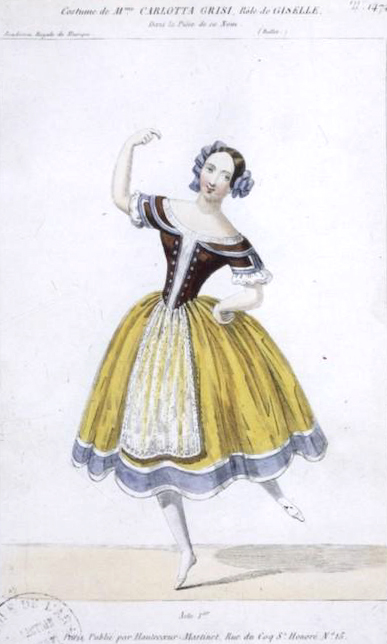
Carlotta Grisi's Birthday - June 28,1819

Carlotta Grisi was an Italian ballet dancer. She was born on June 28, 1819 in Visinada, Istria (now part of Croatia) and died on May 20, 1899 in Saint-Jean, a district of Geneva, Switzerland.


She was trained at the ballet school of Teatro alla Scala in Milan and later with dancer/balletmaster Jules Perrot. At her 1836 debut in London Grisi performed with the accomplished danseur Jules Perrot. She next appeared in Paris at the Théâtre de la Renaissance (1840) and a year later, toured with Perrot to other parts of Europe. Through Perrot's contacts, the pair worked in Paris, London, Vienna, Munich, and Milan where she sang and danced.

Her greatest role however was that of Giselle. The world première of this two-act ballet was on June 28, 1841 at the Theatre de l'Academie Royale de Musique, Paris. The part of Albrecht was danced by Lucien Petipa, (the brother of the great Marius Petipa), with the part of Myrtha, Queen of the Wilis danced by Adele Dumilatre. It caused a sensation and inspired its reviewers to proclaim Giselle to be the greatest ballet of its time and a triumphant successor to the Romantic masterwork La Sylphide. As such, it immediately established Grisi as a star in her very first full-length ballet in Paris. Her salary grew from 5,000 francs to 12,000 in 1842 and 20,000 by 1844, with additional performance fees on top. Grisi's last performance in the west was in Paul Taglioni's Les Métamorphoses (aka Satanella, 1849).


In 1850, she joined Perrot in St. Petersburg, Russia, where he had been appointed balletmaster, and she danced Giselle at the Imperial Bolshoi Kamenny Theatre. The first Giselle in Russia had been danced by Fanny Elssler, and so the initial reaction to Grisi's interpretation of the role was not enthusiastic. However, over time the Russians appreciated her talents. She was Prima Ballerina of the St. Petersburg Imperial Theatres in St. Petersburg from 1850 to 1853, working not only with Perrot but also Joseph Mazilier who staged for her La Jolie Fille de Gand and Vert-Vert especially for her.

In 1854, with her daughter, she left Russia for Warsaw, where she intended to continue dancing, but she became pregnant by Prince Léon Radziwill who then persuaded her to retire from ballet at the height of her fame. Grisi gave birth to her second daughter, Léontine Grisi, and, at the age of 34, settled near Geneva to spend the next forty-six years of her life in peaceful retirement. She died in Saint-Jean, Geneva, Switzerland, on May 20, 1899, a month before her 80th birthday.

Wednesday, May 19, 2010

Prince Igor, Paris Premiere-May 19, 1909

Prince Igor was first performed in St.Petersburg, Russia, in 1890. It is an opera by Alexander Borodin, written in four acts with a prologue. The composer adapted the libretto from the East Slavic epic The Lay of Igor's Host, which recounts the campaign of Russian Prince Igor Svyatoslavich against the invading Polovtsian tribes in 1185. The opera was left unfinished upon the composer's death in 1887 and was edited and completed by Nikolai Rimsky-Korsakov and Alexander Glazunov.

The world premiere of the ballet was given in St. Petersburg on November 4, 1890 at the Mariinsky Theatre. Set designers were Yanov, Andreyev, and Bocharov, while
Lev Ivanov was balletmaster.
Moscow premieres followed later.
The first was given in 1892 by the Russian Opera Society, conducted by Iosif Pribik. The Bolshoi Theatre premiere was given in 1898 and was conducted by Ulrikh Avranek
Other notable premieres were given in Prague in 1899, and in Paris on May 19, 1909, with Sergei Diaghilev's Ballets Russes and Fokine’s choreography. London saw the same production in 1914 conducted by Thomas Beecham.

In 1915, the United States premiere took place at the Metropolitan Opera, but staged in Italian and conducted by Giorgio Polacco.