Diaghilev's Ballets Russes

Diaghilev's Ballets Russes
1909-1929

Welcome Balletomanes

This Blog is dedicated to preserving and celebrating the history and memories of Diaghilev's Ballets Russes, its legendary ballet dancers, choreographers, scenery artists, musicians and composers.
Showing posts with label American Ballet Company. Show all posts

Wednesday, July 27, 2011

Vera Karalli's Birthday! July 27, 1889

Vera was born in Moscow and graduated from the Moscow Theatre School in 1906 under the direction of the prominent Russian instructor Alexander Gorsky. She performed with Diaghilev's Ballets Russes in the premier season in Paris in 1909, as well as 1919 and 1920. She became a soloist at the Bolshoi Theatre after two years and became a Ballerina in 1915. Vera was often paired with danseur Mikhail Mordkin.

In 1914, Vera Karalli also embarked on a successful acting career, and became one of Russia's first celebrated film actresses. Her first role was in the 1914 Pyotr Chardynin directed drama Ty pomnish' li? opposite the successful actor Ivan Mozzhukhin. From 1914 to 1919, Vera Karalli would appear in approximately sixteen Russian silent films, including the 1915 adaptation of Leo Tolstoy's War and Peace entitled Voyna i mir.

Her last film appearance was in a German dramatic release entitled Die Reiche einer Frau in 1921. Often chosen as a leading lady by the notable director Yevgeni Bauer, Karalli is possibly best recalled for her performances in the Bauer directed adaptations of novelist Ivan Turgenev's Posle smerti in 1915 and her role as Gizella in the 1917 melodrama Umirayushchii Lebed.

In 1920, Karalli participated in a large a charity concert at the Paris Opéra along with opera singer and dancer Maria Kuznetsova amongst others, to raise funds to aid impoverished fellow Russian émigrés.

Vera Karalli also taught dance in Kaunas, Lithuania and from 1930 until 1935, Vera was the Ballet Mistress of the Romanian Opera in the capital city of Bucharest. From 1938 until 1941 Karalli lived in Paris, France. Later, she settled in Vienna, Austria and taught ballet there until her death in Baden, Austria in 1972.

Thursday, June 10, 2010

Aynsley Inglis, "For Lena" Rehearsal in NYC


The shawl in the dance, belonged to Madame Antonova (Lena). She was the wife of Leon Woizikowski and a member of Diaghilev's Ballets Russes from 1915. It was given to my daughter as a gift. The dancer is my daughter, Aynsley Inglis.

It is an homage to Lena and the Ballets Russes.

The piece was choreographed by Tony Award winning choreographer, Margo Sappington. It is being performed at the 2010 International Ballet Competition in Jackson, by my daughter who is a competitor there this week.


Friday, March 26, 2010

From Chopiniana to Les Sylphides

The ballet Chopiniana premiered in 1907 at the Maryinsky Theatre in St. Petersburg as Rêverie Romantique: Ballet sur la musique de Chopin. However, this also formed the basis of a ballet, Chopiniana, which took different forms, even in Fokine's hands. The second version was performed in 1908 at the Maryinsky Theatre, danced by Pavlova, Karsavina, Nijinsky and Preobrajenska.

The ballet Chopiniana premiered as Les Sylphides, with Sergei Diaghilev's Ballets Russes on June 2, 1909 at Théâtre du Châtelet, Paris. The Diaghilev premiere is the most famous, as its soloists were Tamara Karsavina, Vaslav Nijinsky (as the poet, dreamer, or young man), Anna Pavlova, and Alexandra Baldina. The London premier, in the first season of the Diaghilev Ballets Russes, was at the Royal Opera House, Covent Garden.


With more sylph-like elusiveness, the North American premiere might be dated by an unauthorized version in the Winter Garden, New York, on 14 June 1911, featuring Baldina alone from the Diaghilev cast. However, its authorized premiere on that continent, by Diaghilev Ballets Russes, was at the Century Theater, New York City, 20 January 1916, with Lopokova . Nijinsky danced it with Ballets Russes at the Metropolitan Opera, April 14, 1916.


Les Sylphides has no plot, but instead consists of many white-clad sylphs dancing in the moonlight with the poet or young man dressed in white tights and a black top. New York City Ballet produced its own staging of the standard version, omitting the Polonaise in A major and leaving the Prelude in A major in its original position, under the original title, Chopiniana. The NYCB premiere was staged by Alexandra Danilova and took place 20 January 1972, at the New York State Theater, Lincoln Center. The original cast included Karin von Aroldingen, Susan Hendl, Kay Mazzo, and Peter Martins.

Monday, March 8, 2010

Cleopatra Premiere's March 8, 1908

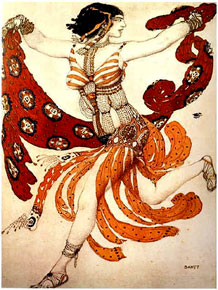
Cleopatra was first performed at a benefit in St. Petersburg at the Maryinsky Theatre on March 8, 1908. It was called Nuit d"Egypte at that time. It was originally staged and choreographed by Fokine, solely to Arensky's score. Most of the costumes that were used were borrowed from La Fille du Pharaon and Aida, only soloist costumes were sketched by Leon Bakst. The set came from one of the operas in the Maryinsky's repertoire, but was touched up by Maryinsky stage designer, Oreste Allegri.

On June 2,1909, Diaghilev's Ballets Russes performed it as Cleopatra at the Theatre du Chatelet as part of their first season in Paris. Fokine talked Diaghilev into using a student of his, a non-professional dancer, for the part of Cleopatra, Ida Rubinstein. The sets and costumes were designed by Leon Bakst a the suggestion of Alexandre Benois.


In 1917, while on their Latin American tour, the set for Cleopatra was destroyed in a fire; in July 1918 Diaghilev ordered a new set to be designed by Robert Delauney. He ordered sketches of the costumes for Lubov Tchernicheva and Leonide Massine, from Delauney's wife Sonia.

After attending the opening night of Cleopatra's debut in Berlin, Kaiser Wilhelm II, urged members of his Society of Egyptology to study Bakst's mise-en-scene.


Thursday, January 21, 2010

Looking Back on Balanchine on His Birthday January 22, 1904

George Balanchine was born Georgi Melitonovitch Balanchivadze, in St. Petersburg, Russia, on January 22, 1904. At the age of 10, he entered the Imperial Ballet School (Vaganova) in St. Petersburg. His teachers were Andreanov, Gerdt, Skiraev and Gavlikovsky. In 1921, he entered the State Academy of Opera and Ballet and used set his earliest choreography on a group of fellow dancers. In 1924, when they were invited to tour Europe as the Soviet State Dancers, Balanchine defected along with Vladimir Dimitriew.

In 1925, just a year later, he was discovered in Paris by Ballets Russes’ Director Serge Diaghilev. When Diaghilev's most famous choreographer, Nijinska, left his ballet company, Balanchine took her place; at the age of 21 he was the Ballet Master and Principal Choreographer of the famed Diaghilev's Ballets Russes. It was Diaghilev who changed George’s name to Balanchine. Balanchine did 10 ballets for Diaghiev's Ballets Russes.

Among his ballets for the Ballets Russes :
Jack in the Box (1926)
Pastorale (1926)
Barabau (1926)
La chatte (1927)
Le Triomphe de Neptune (1927)
Apollo (1928)
The Prodigal Son (1929)
Le Bal (1929)


When Diaghilev died and the company disbanded in 1929, Balanchine moved from one company to another, until in 1933 when he formed his own company, Les Ballets. That same year, he met Lincoln Kirstein, who invited him to head the new School of American Ballet in New York City. Balanchine choreographed Serenade on these students, his first ballet in America.


In 1934, the American Ballet Company became the resident company at the Metropolitan Opera in New York where Balanchine did three new ballets: Apollo, The Card Party, and The Fairy's Kiss. In my own American Ballet Company program dated 1936-1937, the company performed; Errante, Mozartiana, Alma Mater, Transcendence, Serenade, Reminiscence and Dreams, all choreographed by Balanchine. But in the program he is listed as an Instructor along with Vladimiroff, Stuart and Viltzak and Vladimir Dimitriew is listed as the Director of the school. Balanchine's contemporary ballet style and the Metropolitan's conservative artistic policy made this a short lived relationship and was terminated in1938.


In 1941, he choreographed Balustrade, to Stravinsky's violin concerto, for the Original Ballet Russe. He collaborated closely with the composer Igor Stravinsky, who he originally met through Diaghilev when they were in the Ballets Russes together. In total, Balanchine set more than 30 works to Stravinsky’s music. He continued to work with the Original Ballet Russe until 1946. Also in 1941, he joined Ballet Caravan and made a good-will tour of South America for the U. S. State Department.


In 1946, Lincoln Kirstein and Balanchine established a new company, the Ballet Society. The performance of Balanchine's Orpheus was so successful that his company was invited to establish permanent residence at the New York City Center and was renamed the New York City Ballet. Here he created some of his most enduring works, including his Nutcracker and Agon. New York City Ballet moved to Lincoln Center's New York State Theatre in 1964.


Balanchine created more than 150 works for New York City Ballet, including The Nutcracker (1954), Don Quixote (1965), and Jewels (1967), and he also choreographed musicals and operas. Balanchine's work remains in the repertoires of many companies worldwide, and he is widely considered the greatest choreographer of the 20th century. Balanchine died in New York City on April 30, 1983.


Curtsy, Bow, Acknowledge the Orchestra,
Stacey


(Photos: from 1970 NYC-Ballet Program)