Diaghilev's Ballets Russes

Diaghilev's Ballets Russes
1909-1929

Welcome Balletomanes

This Blog is dedicated to preserving and celebrating the history and memories of Diaghilev's Ballets Russes, its legendary ballet dancers, choreographers, scenery artists, musicians and composers.
Showing posts with label Maryinsky Theatre. Show all posts

Wednesday, July 20, 2011

Choreographer Marius Petipa's Passing - July 14, 1910

Marius Petipa was a French ballet dancer, teacher and choreographer who is noted for his long career as Premier Maître de Ballet of the St. Petersburg Imperial Theatres, a position he held from 1871 until 1903. Marius Petipa created over fifty ballets and is considered to be the most influential ballet master and choreographer of ballet that has ever lived.

Petipa revived a substantial number of works created by other Ballet Masters. Many of these revivals would go on to become the definitive editions from which all subsequent productions would be based. The most famous of these revivals are Le Corsaire, Giselle, La Esmeralda, Coppélia, La Fille Mal Gardée (with Lev Ivanov), The Little Humpbacked Horse and Swan Lake (with Lev Ivanov).

Marius Petipa was born in Marseilles, France on March 11,1818. His mother Victorine Grasseau was an actress and drama, teacher, while his father, Jean Antoine Petipa was a renowned Ballet Master and teacher. At the time of Marius's birth, Jean Petipa was a Premier danseur to the the Opéra de Marseille, and in 1819 he was appointed Maître de Ballet to that theatre.

Petipa spent his early childhood travelling throughout Europe as his parents' professional engagements took them from city to city. By the time Marius was 6 years old his family had settled in Brussels, where his father was appointed Maître de Ballet and Premier danseur to the Théâtre de la Monnaie. Petipa received his general education at the Grand College in Brussels, while also attending the Brussels Conservatory where he studied music and learned to play the violin. Jean Petipa began giving Marius ballet lessons at the age of seven. At first the young boy resisted, caring very little for dance. But Marius soon came to love dance so much, and he excelled quickly. In 1827, at the age of 9, Marius performed for the first time in a ballet production in his father's staging of Pierre Gardel's 1800 ballet La Dansomani.

In 1834 the Petipa family relocated to Bordeaux, France. While in Bordeaux, Marius completed his ballet training under the great Auguste Vestris. By 1838 he was appointed Premier danseur to the Ballet de Nantes in Nantes, France. During his time in Nantes the young Petipa began to try his hand at choreography by creating a number of one-act ballets and divertissements.

By 1840, Petipa had made his début as a dancer with the famous Comédie Française in Paris, and during his first performance with the troupe he partnered the legendary Ballerina Carlotta Grisi in a benefit performance. In 1847, Petipa accepted the position of Premier danseur to the Imperial Theatres of St. Petersburg. The position was available due to the departure of the French danseur Emile Gredlu.

For Petipa's début, the director of the Imperial Theatres Alexander Gedeonov commissioned Petipa and the Ballet Master Pierre-Frédéric Malevergne to mount the first Russian production of Joseph Mazilier's ballet Paquita, first staged at the Paris Opéra in 1846. The ballet was given for the first time in St. Petersburg on October 8, 1847 with the Prima ballerina Yelena Andreyonova as Paquita and Petipa in the role of Lucien d’Hervilly.


The following season Petipa and his father staged a revival of Mazilier's 1840 ballet Le Diable amoureux which premiered as Satanella on February 22, 1848. The Prima Ballerina Andreyonova performed the title role, with Petipa as Fabio.

During his career, Petipa choreographed ballets and revivals including:

*Paquita (1847, *1881),*Le Corsaire (1858, 1863, 1868, 1885, 1899),The Pharaoh's Daughter (1862, *1885, *1898), Le Roi Candaule (1868, *1891, *1903), Don Quixote (1869, *1871), La Bayadère (1877, *1900), *Giselle (1884, 1899, 1903), *Coppélia (1884), *La fille mal gardée (1885), *La Esmeralda (1886, 1899), The Talisman (1889), The Sleeping Beauty (1890)
The Nutcracker (1892), Cinderella (1893), The Awakening of Flora (1894),*Swan Lake (1895)
*The Little Humpbacked Horse (1895), Raymonda (1898), The Seasons (1900), Harlequinade (1900).

Marius Petipa died on July 14, 1910 at the age of ninety-two, and was interred three days later in the Alexander Nevsky Monastery in St. Petersburg.(Petipa's funeral - photo above)

Wednesday, July 13, 2011

Alexandra Danilova Passed Away July 13, 1997

Alexandra Danilova, or Choura, was born in Peterhorf, Russia on November 20,1903. She trained at the Imperial School of Ballet in St. Petersberg, Russia. After her graduation, she was asked to join the Corps de Ballet of the Soviet State Ballet at the Maryinsky Theatre. Danilova left Russian with the Soviet State Dancers, a company formed by fellow dancer Vladimir Dimitriev. During summer vacation from performances at the Maryinsky, the company toured Berlin, Germany and the dancers defected, never to return to Russia again. The company left Berlin, heading to London, where Danilova joined Diaghilev's Ballets Russes in 1924. When Danilova was asked to audition for Diaghilev, she refused, telling him, "If I am good enough for the Maryinsky, then I am good enough for you." That same year, George Balanchine joined Diaghilev's Ballets Russes as choreographer.

When Diaghilev died suddenly in 1929, his company was disbanded. Dancers were left to find other companies to dance for, but Danilova was 28 and considered too old for most companies. She was eventually offered a position with the new Col. de Basil's Ballet Russe , by her friend Leonide Massine.

Quickly, as one of the most popular dancers of her time, many theatre's would not book Col. de Basil's Ballet Russe without Danilova! She danced with the Ballet Russe de Monte Carlo from 1938 - 1945 where she was often partnered by Freddie Franklin. Danilova also guested with Sadler Wells in 1949, London Festival Ballet in 1952 and created her own "Great Moments of Ballet" tour dancing from 1954-1956.

Her last ballet performance was in 1957, but she appreared in a Broadway comedy/musical in 1958 called Oh, Captain!. She appeared in a single scene, a dance with the show's star, Tony Randall, which stole the show. Danilova was never good at handling her finances and found herself broke and unemployed again when ran into her friend George Balanchine on the streets of New York City in 1964. She told him of her plight and he instantly hired her to teach at the School of American Ballet. She remained with SAB until her retirement in 1989.

During her career, Danilova danced all the major ballerina roles and created principal roles in Balanchine works like The Triumph of Neptune (1926), Le Bal (1928), Dances Concertantes (1944) and La Sonnambula (1946). and she Choreographed Coppelia for NYCB in 1974. Danilova was a recipient of the Kennedy Center Honors in 1989. Danilova did make an appearance in the movie "The Turning Point" as a ballet teacher and coach.

Her autobiography, Choura, was published in 1986. There is a fabulous little documentary on Felia Doubrovska, that Danilova appears in. She and Felia are restaging a variation for Mikhail Baryshnikov.

Thursday, July 7, 2011

Vera Trefilova Passed Away July 11, 1943

Vera Trefilova was born in Vladikavkaz, Russia on October 8, 1875. She studied at the Imperial Ballet School and graduated in 1894. She joined the Mariinsky Theatre in 1894 and was promoted to soloist in 1901. Vera became prima ballerina in 1906 at the Maryinsky, known for her 32 fouettés. She created roles in Lev Ivanov's Acis and Galatea (1896), N. and S. Legat's The Fairy Doll (1903), N. Legat's The Blood-Red Flower (1907), and Mikhail Fokine's The Night of Terpsichore (1907). She was triumphant as Princess Aurora in Sleeping Beauty, but resigned in 1910 due to a rivalry with ballerina Mathilde Kschessinska.

In 1917 Vera left Russia during the revolution and opened a school in Paris. In 192,1 Diaghilev invited her to dance Princess Aurora in the London performances of his Ballets Russes’ Sleeping Princess, she alternated the role with Olga Spessivtseva. She danced Odette-Odile with Diaghilev’s Ballets Russes in 1924 when she was almost 50 years old, but she still amazed the audience.

She gave her final performance at His Majesty's Theatre in London in 1926. She was married to the dance critic Valerian Svetlov. Vera passed away in Paris July 11, 1943.

Thursday, May 20, 2010

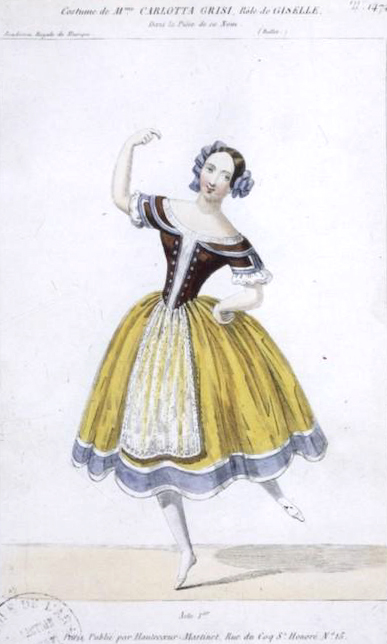
Carlotta Grisi's Birthday - June 28,1819

Carlotta Grisi was an Italian ballet dancer. She was born on June 28, 1819 in Visinada, Istria (now part of Croatia) and died on May 20, 1899 in Saint-Jean, a district of Geneva, Switzerland.


She was trained at the ballet school of Teatro alla Scala in Milan and later with dancer/balletmaster Jules Perrot. At her 1836 debut in London Grisi performed with the accomplished danseur Jules Perrot. She next appeared in Paris at the Théâtre de la Renaissance (1840) and a year later, toured with Perrot to other parts of Europe. Through Perrot's contacts, the pair worked in Paris, London, Vienna, Munich, and Milan where she sang and danced.

Her greatest role however was that of Giselle. The world première of this two-act ballet was on June 28, 1841 at the Theatre de l'Academie Royale de Musique, Paris. The part of Albrecht was danced by Lucien Petipa, (the brother of the great Marius Petipa), with the part of Myrtha, Queen of the Wilis danced by Adele Dumilatre. It caused a sensation and inspired its reviewers to proclaim Giselle to be the greatest ballet of its time and a triumphant successor to the Romantic masterwork La Sylphide. As such, it immediately established Grisi as a star in her very first full-length ballet in Paris. Her salary grew from 5,000 francs to 12,000 in 1842 and 20,000 by 1844, with additional performance fees on top. Grisi's last performance in the west was in Paul Taglioni's Les Métamorphoses (aka Satanella, 1849).


In 1850, she joined Perrot in St. Petersburg, Russia, where he had been appointed balletmaster, and she danced Giselle at the Imperial Bolshoi Kamenny Theatre. The first Giselle in Russia had been danced by Fanny Elssler, and so the initial reaction to Grisi's interpretation of the role was not enthusiastic. However, over time the Russians appreciated her talents. She was Prima Ballerina of the St. Petersburg Imperial Theatres in St. Petersburg from 1850 to 1853, working not only with Perrot but also Joseph Mazilier who staged for her La Jolie Fille de Gand and Vert-Vert especially for her.

In 1854, with her daughter, she left Russia for Warsaw, where she intended to continue dancing, but she became pregnant by Prince Léon Radziwill who then persuaded her to retire from ballet at the height of her fame. Grisi gave birth to her second daughter, Léontine Grisi, and, at the age of 34, settled near Geneva to spend the next forty-six years of her life in peaceful retirement. She died in Saint-Jean, Geneva, Switzerland, on May 20, 1899, a month before her 80th birthday.

Wednesday, May 19, 2010

Prince Igor, Paris Premiere-May 19, 1909

Prince Igor was first performed in St.Petersburg, Russia, in 1890. It is an opera by Alexander Borodin, written in four acts with a prologue. The composer adapted the libretto from the East Slavic epic The Lay of Igor's Host, which recounts the campaign of Russian Prince Igor Svyatoslavich against the invading Polovtsian tribes in 1185. The opera was left unfinished upon the composer's death in 1887 and was edited and completed by Nikolai Rimsky-Korsakov and Alexander Glazunov.

The world premiere of the ballet was given in St. Petersburg on November 4, 1890 at the Mariinsky Theatre. Set designers were Yanov, Andreyev, and Bocharov, while
Lev Ivanov was balletmaster.
Moscow premieres followed later.
The first was given in 1892 by the Russian Opera Society, conducted by Iosif Pribik. The Bolshoi Theatre premiere was given in 1898 and was conducted by Ulrikh Avranek
Other notable premieres were given in Prague in 1899, and in Paris on May 19, 1909, with Sergei Diaghilev's Ballets Russes and Fokine’s choreography. London saw the same production in 1914 conducted by Thomas Beecham.

In 1915, the United States premiere took place at the Metropolitan Opera, but staged in Italian and conducted by Giorgio Polacco.

Sunday, April 25, 2010

A Diaghilev Choreographer: Mikhail Fokine (1880-1942)

Mikhail was born in St. Petersburg on April 25, 1880 and studied at the Imperial School. He graduated at the age of 18, immediately entering the Maryinsky Theatre. He was promoted to soloist in 1904. He started teaching at the Imperial School and choreographed his first ballet, for a student performance, Acia and Galatea in 1905.

Mikhail Fokine is one of, if not the, best known choreographer of the 20th century. His ballets are still performed by ballet companies worldwide. In 1907, he choreographed The Dying Swan for Anna Pavlova, in Carnival of Animals which became her iconic solo. He also created Firebird for Pavlova, but after hearing Stravinsky’s music she refused to dance it, so Tamara Karsavina danced it.

The first ballet Fokine choreographed for the Maryinsky Theatre was Le Pavillon d'Armide. This ballet was included in the repertoire of the first season of Diaghlev's Ballets Russes, in Paris in 1909. He became Diaghlev's chief choreographer, while continuing to dance in Russia until 1918.
Fokine left the Ballets Russes in 1912 because Diaghilev was favoring Vaslav Nijinsky's choreography. He freelanced, finally settling in the United States in 1923. He married Vera Antonova Fokina, they had often been partners in Diaghilev's Ballets Russes. Fokine originally choreographed Chopiniana, to later be renamed Les Sylphides, for a performance outside the Maryinsky in 1907. He restaged Les Sylphides for the then Ballet Theatre's, now ABT, inaugural performance in 1940 at New York's Center Theatre.

Tuesday, March 30, 2010

Serge Lifar - April 2nd Birthday Celebration!


Serge Lifar was born on April 2, 1903 in Kiev, Ukraine and trained there by Bronislava Nijinska. Lifar was dynamic and controversial in his personal life. He was accepted into the Ballets Russes in 1923. Serge Lifar's career was delayed a year because he did not accept Serge Diaghilev's invitation to breakfast. Diaghilev insisted that Lifar's training continue with Enrico Cecchetti, Nicolai Legat and Pierre Vladimirov. Lifar was known for his notorious and unscrupulous displays of ego. While partnering Alicia Markova at London's Drury Lane Theatre, his extremely unprofessional jealousy of her triumph caused a scandal. In 1938, they danced again when Markova was making her debut in America. The ballet was almost ruined by Lifar's attempts to steal scenes, causing a critic to write that his performance in Giselle would justify changing the name of the ballet to Albrecht.

Lifar eventually replaced Anton Dolin as Diaghilev's favorite, when Dolin left to dance in Cochran's Revues with Vera Nemtchinova. Diaghilev made sure Lifar continued his daily classes with Enrico Cecchetti. Wherever Lifar went, Cecchetti was there to give him lessons. Lifar was the last of the Ballets Russes' Premier Danseurs, although Dolin did return to the company as one of the stars. Two of Lifar's greatest achievements as a dancer in the Ballets Russes were in Balanchine's Apollo and The Prodigal Son.


After Serge Diaghilev's death in 1929, Lifar became Premier Danseur of the Paris Opera Ballet, whose reputation had declined since the Victorian era. By 1933, he had become its Director and Professor of Dance. In 1939, Lifar joined the Ballet Russe de Monte Carlo where he again danced with Alicia Markova, this time at London's Covent Garden.

Lifar held the position of Director at the Paris Opera Ballet for 20 years, creating 90 percent of the choreography and dancing many leading roles. Although he himself was trained by Cecchetti, he replaced the Italian technique at the Paris Opera with the modern Russian Vaganova School, named for the great Kirov teacher Aggripina Vaganova. He remained as director of the Paris Opera Ballet until 1945, when charges of collaboration with the Germans caused him to leave and become director of the Nouveau Ballet de Monte Carlo. Lifar, cleared of the charges and given a year's suspension, returned as director of the Paris Opera Ballet in 1947. In 1949, he danced again, and his last performance at the Opera was as Albrecht in ''Giselle'' in 1956. He resigned as director in 1958, although he was briefly re-engaged as choreographer in 1968.


In the summer of 1994 on the stage of the National Ukraine Opera the First International Ballet Contest was held named after Serge Lifar. The new contest happened to be unique. For the first time in Europe young ballet artists and balletmasters contended simultaneously. The Sixth Lifar International Ballet Competition was held in April, 2006.

Friday, March 26, 2010

From Chopiniana to Les Sylphides

The ballet Chopiniana premiered in 1907 at the Maryinsky Theatre in St. Petersburg as Rêverie Romantique: Ballet sur la musique de Chopin. However, this also formed the basis of a ballet, Chopiniana, which took different forms, even in Fokine's hands. The second version was performed in 1908 at the Maryinsky Theatre, danced by Pavlova, Karsavina, Nijinsky and Preobrajenska.

The ballet Chopiniana premiered as Les Sylphides, with Sergei Diaghilev's Ballets Russes on June 2, 1909 at Théâtre du Châtelet, Paris. The Diaghilev premiere is the most famous, as its soloists were Tamara Karsavina, Vaslav Nijinsky (as the poet, dreamer, or young man), Anna Pavlova, and Alexandra Baldina. The London premier, in the first season of the Diaghilev Ballets Russes, was at the Royal Opera House, Covent Garden.


With more sylph-like elusiveness, the North American premiere might be dated by an unauthorized version in the Winter Garden, New York, on 14 June 1911, featuring Baldina alone from the Diaghilev cast. However, its authorized premiere on that continent, by Diaghilev Ballets Russes, was at the Century Theater, New York City, 20 January 1916, with Lopokova . Nijinsky danced it with Ballets Russes at the Metropolitan Opera, April 14, 1916.


Les Sylphides has no plot, but instead consists of many white-clad sylphs dancing in the moonlight with the poet or young man dressed in white tights and a black top. New York City Ballet produced its own staging of the standard version, omitting the Polonaise in A major and leaving the Prelude in A major in its original position, under the original title, Chopiniana. The NYCB premiere was staged by Alexandra Danilova and took place 20 January 1972, at the New York State Theater, Lincoln Center. The original cast included Karin von Aroldingen, Susan Hendl, Kay Mazzo, and Peter Martins.

Friday, March 19, 2010

Sergei Pavlovich Diaghilev: Birthday


Sergei Diaghilev was born March 19, 1872, in Perm, Russia, into a wealthy noble family of Novgorod, Russia. His father, named Pavel Diaghilev, was a distinguished General to the Russian Tsar Nicholas II. His mother died at his birth. Young Sergei Diaghilev grew up in a highly cultured environment. He studied piano and singing from the early age. He also took lessons in painting at the St. Petersburg Academy of Arts, and studied music with Nikolai Rimsky-Korsakov at the St. Petersburg Conservatory. From 1891-1896 Diaghilev studied law and graduated from the Law Department of the St. Petersburg University. There he developed a life-long friendship with his fellow law student Alexandre Benois. As a law student he came to St. Petersburg where he became co-founder of the progressive art magazine Mir Iskusstva (The World of Art) in 1899. The same year he was appointed artistic adviser of the Maryinsky Theatre. He resigned this post in 1901 and when the magazine stopped publishing in 1904, he concentrated on organizing exhibitions of Russian art in St. Petersburg and Paris. In 1908 he brought a production of "Boris Godunov" to Paris, with the famous singer, Feodor Chaliapin.

In 1909 he brought to Paris a season of opera and ballet and, with the best dancers from the Maryinsky, he scored a great success. Repeat visits in the following years resulted in the formation of the Ballets Russes in 1911 as an independent private company, which he directed until his death in 1929. He never returned to Russia after the 1917 revolution. In fact, Diaghilev's Ballets Russes never performed in Russia. Prior to 1909 most ballet companies were a part of an opera company or were subsidized by the court or the ruling power. The Paris Opera was the home of the ballet, even in Russia the ballet was part of the opera. In 1909 when Diaghilev decided to bring a small company of dancers to Paris he did this by bringing the great opera star Chaliapin to share the program. Both people in Russia and Paris thought that he was crazy. Diaghilev didn't had an easy time getting enough money to get the this project to Paris. Once he accomplished the first season in Paris he had to do this during the dancers yearly time off. He had to get them back to St. Petrersburg before their season started.

Diaghilev collaborated with the most famous artists, composers and dancers of the period. Artists like Alexandre Benois, Leon Bakst, Nicolas Roerich, Pablo Picasso, Henri Matisse. He got composers such as Igor Stravinsky, Sergei Prokofiev, Maurice Ravel, Claude Debussey and Erik Satie to name a few, to compose new music for the ballet. He encouraged Mikhail Fokine, Vaslav Nijinsky, Leonide Massine, Bronislava Nijinska and George Balanchine to choreograph new ballets for the company.

Diaghilev never went to sleep without thinking of some way to get enough money to spawn a new ballet. After his death in 1929 the company that he had worked so hard to create disbanded. It took until 1933 before another company could get the funding and leadership to start a new season, using many of the dancers that had been with Diaghilev's Ballets Russes.

Wednesday, January 27, 2010

Olga Preobrajenska: February's Featured Ballerina Part I


Olga was born on February 2, 1870 in St.Petersburg and was trained at the Imperial Ballet Academy. She studied with such teachers as Enrico Cecchetti, Christian Johansson, and Nicholas Legat. Olga graduated in 1889 and immediately joined the Maryinsky Theatre. In 1896 she was made a soloist, and four years later, Prima Ballerina. Olga Preobrajenska was one of St. Petersburg's beloved Prima Ballerinas. The audiences loved both her personality and her strong technique. Her extensive repertoire included leading roles in Coppellia, La Fille Mal Gardee, Esmeralda, The Nutcracker, Sleeping Beauty, and Les Sylphides.

Olga dominated the ballet stage for the first two decades of the twentieth century. She appeared in over 700 productions in addition to participating in several tours.

Later, Olga became very well known as a teacher. She started teaching in 1914 while she continued to dance. After leaving the Soviet Union in 1921, Olga taught in Milan, London, Buenos Aires, and Berlin before she settled permanently in Paris in 1923. Nearly every famous dancer of the time was trained by her at "Salle Wacker," including Irina Baronova, Tamara Toumanova, Tatiana Riabouchinska,Igor Youskevitch, Olga Spessiva, Anna Pavlova and Margot Fonteyn. Agrippina Vaganova was also a student of Olga's. Agrippina Vaganova later created her method of dance taught by the Maryinsky Theatre and other major ballet schools, to this day.


It was also in her Paris studio, Salle Wacker, that Balanchine came when looking for young dancers for the Ballets Russes. This is where he found his “baby ballerinas”: Toumanova, Baronova, and Riabouchinskaya.


For many years, Olga's Paris studio, at 69 Rue de Douai, was the unofficial networking centre for the international dance community until it was demolished in 1974. Olga had continued to teach until she was 90 years old, retiring in 1960. She died two years later.